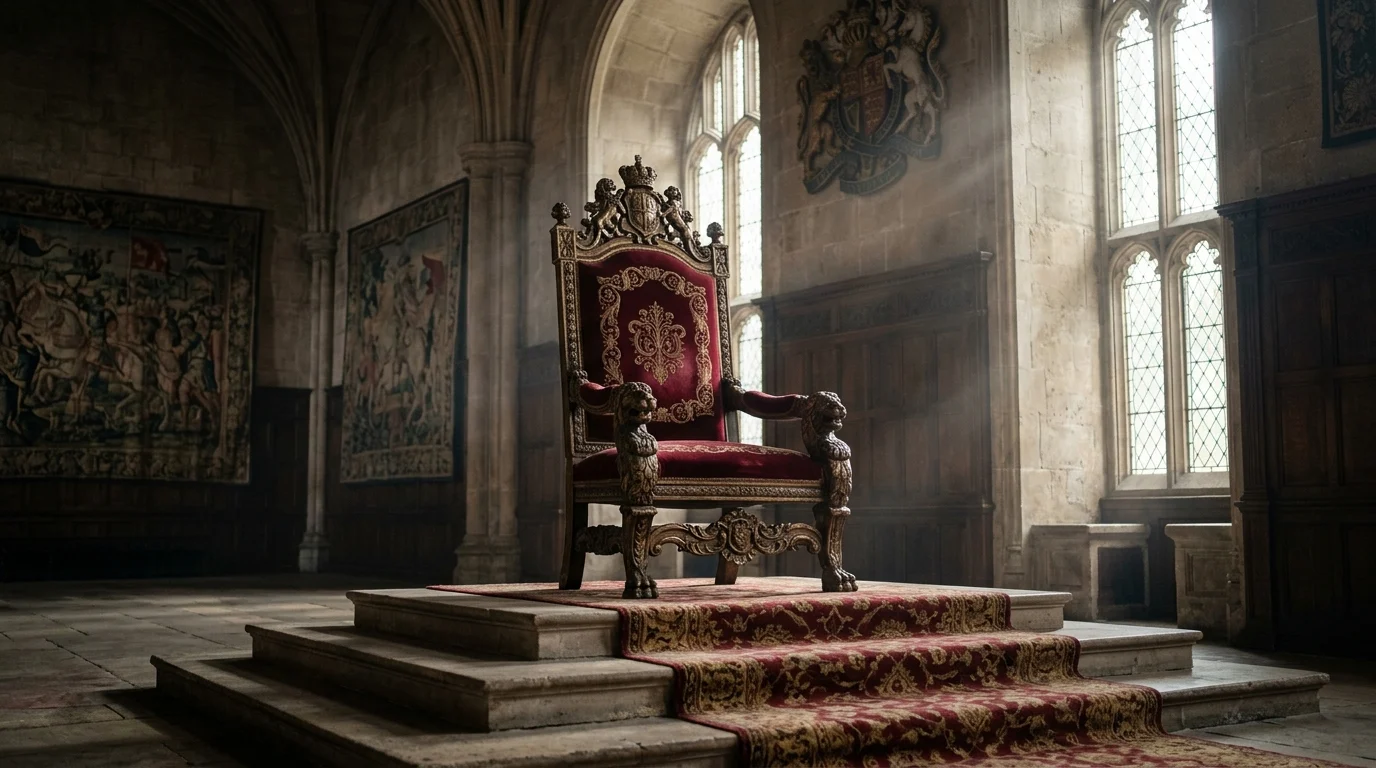
A throne is much more than a seat reserved for a king or queen. Throughout history, throne symbolism has represented power, authority, leadership, divine presence, justice, and the responsibility that comes with ruling others. From ancient royal palaces to religious scriptures and modern literature, the throne remains a powerful image of status, control, and spiritual significance.
But what does a throne truly symbolize? Its meaning depends on the context in which it appears. A golden throne may represent wealth and prestige, while an empty throne can suggest absence, uncertainty, or a lost ruler. In spiritual traditions, a throne may symbolize divine authority, inner strength, or a higher power governing the universe.
Understanding throne symbolism helps reveal deeper meanings in history, religion, dreams, art, and everyday life.
Throne Symbolism Meaning (Clear Definition)
Throne symbolism is the use of a throne to represent power, authority, leadership, sovereignty, divine presence, and social status. It can also symbolize responsibility, justice, ambition, pride, or the burden of leadership.
Traditionally, a throne is associated with a ruler who possesses the authority to make decisions and guide a kingdom. Because of this connection, the throne often represents not only the person who occupies it but also the institution, kingdom, or principles that person represents.
The meaning changes depending on the situation:
- Power and authority: The ability to govern, influence, or make important decisions.
- Royal status: Wealth, prestige, honor, and a position of distinction.
- Divine authority: A sacred presence or a higher power.
- Justice and judgment: The responsibility to make fair decisions.
- Wisdom and leadership: The ability to guide others with understanding.
- Pride and ambition: The desire for recognition, control, or superiority.
- Responsibility: The duties and consequences that accompany authority.
For example, a king seated confidently on a throne may represent stable leadership. A damaged throne might suggest a declining kingdom or weakened authority, while an empty throne could symbolize uncertainty about who should lead.
The key to interpreting a throne is to consider who occupies it, where it appears, and what happens around it.
What Does Throne Symbolism Represent?
Throne symbolism carries several interconnected meanings. Although power is its most recognizable association, the symbol can also communicate emotional, moral, and spiritual ideas.
1. Power and Authority
The throne is one of the clearest symbols of authority. It represents the right or ability to lead, govern, and influence others.
In monarchies, the throne signifies the sovereign’s position and the continuity of royal power. In a broader sense, it can represent any position that carries significant responsibility or influence.
A throne in a story, for instance, may represent the ultimate position of power that characters compete to obtain.
2. Leadership and Responsibility
A throne is not simply a reward for achieving greatness. It also represents the obligations that come with leadership.
A ruler must make difficult decisions, protect people, and consider the consequences of their actions. For this reason, throne symbolism can remind us that genuine leadership requires wisdom, fairness, and accountability.
The throne may look magnificent, but the responsibilities attached to it can be demanding.
3. Wealth and Prestige
Many historical thrones were made from expensive materials, including gold, ivory, carved wood, and precious stones. Their elaborate designs communicated the wealth and importance of the ruler.
A jeweled throne may therefore symbolize abundance, luxury, social status, and public recognition.
However, this symbolism can also carry a warning. When a throne becomes an expression of vanity or excessive ambition, it may represent pride rather than genuine greatness.
4. Justice and Judgment
In many traditions, rulers are expected to settle disputes and uphold the law. The throne consequently becomes a symbol of judgment and the responsibility to distinguish right from wrong.
A ruler sitting on a throne to hear a case may represent the search for truth, fairness, and accountability.
In religious imagery, a heavenly throne may symbolize ultimate judgment and the belief that all actions are subject to a higher moral authority.
5. Stability and Order
A throne can symbolize the stability of a kingdom, institution, or established system of government.
When a ruler occupies the throne peacefully, the image may suggest continuity, security, and social order. When the throne is threatened, overturned, or abandoned, it can signify political instability, conflict, or the collapse of an established system.
6. Ambition and the Desire for Control
The throne often represents something people deeply desire: influence, recognition, or control over their circumstances.
In stories about royal succession, the struggle for a throne may reveal jealousy, greed, courage, or determination. The symbol becomes a way to explore what people are willing to sacrifice to achieve their ambitions.
It can also encourage an important question: Is the desire for power motivated by a wish to serve others or simply by a need to dominate them?
Summary of Throne Symbolism
| Symbolic meaning | What it represents |
| Power | Influence and control |
| Authority | The right to lead or govern |
| Spirituality | Divine presence and sacred sovereignty |
| Justice | Fairness, judgment, and accountability |
| Wealth | Prosperity, luxury, and prestige |
| Wisdom | Responsible and thoughtful leadership |
| Ambition | The pursuit of status or influence |
| Stability | Order, continuity, and security |
| Absence | Uncertainty, loss, or an unclaimed position |
Spiritual Meaning of Throne Symbolism
Spiritually, throne symbolism often represents a higher source of authority, inner wisdom, spiritual order, and the relationship between human life and the sacred.
Its interpretation varies across beliefs and personal experiences, but several themes appear repeatedly.
Divine Authority and Higher Power
In many spiritual traditions, a throne represents the supreme authority of a divine being. Unlike an ordinary ruler, this authority is understood as transcending human limitations.
A throne surrounded by light, angels, or heavenly imagery may communicate holiness, majesty, protection, or the presence of a power greater than oneself.
For believers, this imagery can reinforce the idea that the universe is governed by a meaningful spiritual order.
Inner Strength and Self-Mastery
A throne can also serve as a metaphor for personal authority.
Imagine someone sitting calmly on a throne in a symbolic image. Rather than representing domination over others, the scene might represent control over personal reactions, confidence in one’s values, and the ability to make thoughtful decisions.
In this interpretation, claiming your throne means recognizing your worth and taking responsibility for your choices.
It does not mean believing you are superior to others. Instead, it suggests becoming grounded enough to lead your own life with purpose.
Spiritual Awakening and Wisdom
A throne may symbolize the attainment of wisdom or a deeper understanding of existence.
In symbolic artwork, a throne positioned high above the ground can suggest spiritual elevation, enlightenment, or a perspective that extends beyond everyday concerns.
Such meanings depend on the surrounding imagery and the tradition in which the symbol appears. A throne does not automatically signify spiritual awakening, but it can be used to communicate that idea.
Balance Between Power and Humility
One of the most meaningful spiritual lessons associated with a throne is that authority should be balanced by humility.
Power without compassion can become destructive. Leadership guided by wisdom, however, can create stability and encourage others to flourish.
The spiritual message is therefore not simply to seek a higher position. It is to become worthy of the responsibilities that position represents.
Biblical / Religious Meaning of Throne Symbolism
In the Bible and several other religious traditions, the throne is a significant symbol of divine sovereignty, judgment, holiness, and the relationship between heaven and earth.
Its meaning depends on the specific passage, tradition, and imagery involved.
Throne Symbolism in the Bible
The Bible frequently uses throne imagery to communicate God’s kingship and authority.
In Psalm 103:19, God’s throne is described as established in the heavens, emphasizing divine sovereignty over creation. The image presents God’s rule as extending beyond any earthly kingdom.
In Isaiah 6:1, the prophet describes seeing the Lord seated on a high and exalted throne. The vision emphasizes divine majesty and holiness.
Revelation also contains powerful throne imagery. In Revelation 4, a throne in heaven becomes the central focus of a vision filled with worship, heavenly beings, and descriptions of divine glory.
These passages illustrate several biblical themes:
- God’s sovereignty: Divine authority over creation.
- Holiness: The sacred nature of God’s presence.
- Judgment: The authority to evaluate human actions.
- Worship: The recognition of divine greatness.
- Heavenly order: The idea that creation exists within a larger divine purpose.
The Throne of Grace
Hebrews 4:16 uses the expression “throne of grace” to encourage believers to approach God confidently to receive mercy and help.
Here, the throne is not presented merely as a symbol of distant authority. It is also associated with compassion, access to divine assistance, and the possibility of receiving grace.
This interpretation brings together two seemingly different ideas: supreme power and loving mercy.
The Throne of David
The throne of David represents the Davidic royal line and God’s covenant with David in biblical tradition.
In 2 Samuel 7, God makes promises concerning David’s house and kingdom. Later biblical passages connect the Davidic throne with expectations of an enduring kingdom and, in Christian interpretation, the messianic reign of Jesus.
Consequently, the throne of David can symbolize royal legitimacy, covenant, continuity, and hope.
Throne Symbolism in Christianity
In Christian art and theology, a throne may represent God’s majesty, Christ’s kingship, divine judgment, or heavenly glory.
The image of Christ enthroned is particularly important in religious artwork. It portrays Christ as sovereign and victorious, often surrounded by angels, saints, or other sacred figures.
The throne can also serve as a reminder that spiritual authority is associated with righteousness rather than merely worldly status.
Throne Symbolism in Other Religions
Throne imagery also appears in other religious and cultural traditions, although its meaning is not identical across them.
In Islamic tradition, the Qur’an refers to the Throne of God, or al-‘Arsh, including in Ayat al-Kursi (Qur’an 2:255). This imagery expresses God’s supreme majesty and sovereignty; it should not be reduced to the meaning of an ordinary physical throne.
In Hindu traditions, deities and revered spiritual figures are frequently depicted seated on elaborate thrones or sacred seats. These images can communicate divine dignity, spiritual authority, and honored status, depending on the deity and context.
Across these traditions, the throne often expresses an authority greater than ordinary human power, but each tradition gives the symbol its own theological meaning.
Throne Symbolism in History and Culture
Thrones have played an important role in political life, royal ceremonies, and cultural identity for thousands of years.
Their designs, materials, and placement often communicated who held power and how that power was understood.
Ancient Civilizations
In ancient Egypt, royal seats and ceremonial furnishings were associated with the pharaoh’s kingship, divine connections, and authority over the kingdom.
In ancient Mesopotamia, rulers used ceremonial settings and royal imagery to communicate political legitimacy and their relationship with the gods.
In ancient Greece and Rome, elevated seats could indicate distinction and authority, while elaborate seating arrangements helped express social rank.
Although the specific meanings differed, thrones and other seats of honor helped make hierarchy visible.
Medieval Kings and Queens
During the medieval period, European thrones became important symbols of monarchy, inheritance, and political legitimacy.
Coronation ceremonies often emphasized the ruler’s relationship with the kingdom, religious institutions, and established traditions. The throne served as a focal point for these rituals.
A monarch’s authority was therefore communicated not only through laws or military strength but also through ceremonies, clothing, regalia, and the throne itself.
The Peacock Throne
One famous example is the Peacock Throne commissioned for Mughal emperor Shah Jahan in the seventeenth century.
Known for its extraordinary luxury and jeweled decoration, the throne became a powerful representation of Mughal imperial wealth and grandeur. Its name is associated with the peacock figures that decorated it.
The original throne was taken during Nader Shah’s invasion of Delhi in 1739. Its history illustrates how royal objects could embody a ruler’s prestige and become symbols of conquest and political change.
The Iron Throne in Popular Culture
The Iron Throne from George R. R. Martin’s A Song of Ice and Fire series, popularized through the television adaptation Game of Thrones, offers a modern interpretation of royal symbolism.
Constructed from the swords of defeated enemies within the fictional world, the throne represents conquest, fear, political legitimacy, and the dangerous consequences of ambition.
Its uncomfortable design is particularly meaningful: ruling is not portrayed as an effortless privilege but as a position surrounded by conflict and risk.
Why Thrones Matter Across Cultures
Throne symbolism continues to resonate because it makes abstract ideas visible.
A throne gives physical form to concepts such as authority, legitimacy, hierarchy, and responsibility. Even when monarchy is no longer the main political system, the image remains recognizable because people understand what it means to occupy a position of influence.
Throne Symbolism in Literature and Art
In literature and art, the throne often functions as more than a background object. It can become a central symbol that reveals a character’s ambitions, moral qualities, or relationship with power.
The Throne as a Symbol of Ambition
In stories about kingdoms and political rivalry, the throne frequently represents the ultimate prize.
Characters may pursue it for noble reasons, such as protecting their people, or selfish ones, such as gaining wealth and control. Their behavior reveals whether they understand leadership as a responsibility or a personal possession.
Shakespeare’s Macbeth, for example, explores the destructive consequences of ambition and the desire to obtain royal power through murder. Although the throne is not the sole focus of the play, kingship and succession are central to its conflicts.
The Empty Throne
An empty throne can suggest a ruler’s death, an abandoned kingdom, a succession crisis, or a power vacuum.
In a painting, an empty throne surrounded by shadows might communicate loneliness or uncertainty. In a novel, it may create suspense by raising questions about who will claim authority next.
The symbol can also represent an opportunity that has not yet been claimed.
The Golden Throne
A golden throne commonly represents wealth, prestige, glory, and exceptional status.
However, its interpretation depends on how it is portrayed. A radiant golden throne may suggest legitimate authority or prosperity, while one surrounded by suffering may criticize greed, inequality, or the corrupting influence of wealth.
The contrast between outward splendor and inner character often gives the image its meaning.
The Broken or Overturned Throne
A broken throne may symbolize the fall of a ruler, the end of a dynasty, or the collapse of an established order.
In political artwork, this image can communicate revolution or resistance. In personal narratives, it may represent the loss of status or the realization that power is temporary.
The Throne in Religious Art
Religious paintings, sculptures, and illuminated manuscripts often portray sacred figures seated on thrones to communicate majesty and spiritual authority.
The surrounding details help clarify the meaning. Angels may suggest heavenly glory, books may signify wisdom or judgment, and elaborate ornamentation may emphasize honor or sovereignty.
To interpret a throne in art, consider its occupant, location, materials, posture, and relationship to other figures.
Dream Meaning of Throne Symbolism
Dreaming about a throne can be interpreted in several ways, depending on the dreamer’s emotions, circumstances, and personal associations.
There is no universally established meaning for every throne dream. Dreams are subjective experiences, and symbolic interpretations should be treated as possibilities rather than predictions.
Dreaming of Sitting on a Throne
Sitting on a throne may reflect a desire for recognition, confidence, independence, or greater control over your life.
If you feel peaceful while sitting on it, the dream might reflect a growing sense of self-worth. If you feel anxious or overwhelmed, it could reflect concerns about responsibility or expectations.
Dreaming of Seeing an Empty Throne
An empty throne may represent uncertainty, an opportunity, or a role that needs to be filled.
It might also reflect a transition in which familiar leadership or sources of security are changing. The dream’s emotional tone can help you explore which interpretation feels most relevant.
Dreaming of a Golden Throne
A golden throne may bring to mind success, achievement, recognition, or material aspirations.
It can also invite reflection on whether external rewards have become more important than personal values and relationships.
Dreaming of a Broken Throne
A broken throne might reflect worries about losing influence, experiencing a setback, or seeing an important structure in your life change.
Rather than treating the dream as a prediction of failure, consider whether you are currently dealing with uncertainty at work, in relationships, or in a leadership role.
Dreaming of Someone Else Sitting on a Throne
Seeing another person on a throne may relate to admiration, authority, competition, or feelings about your position in a relationship or group.
Your emotional response matters. Respect may point toward qualities you admire, while resentment could encourage you to examine feelings about fairness, recognition, or control.
Ultimately, the most useful approach is to connect the dream’s imagery with your actual experiences instead of assuming it reveals a fixed future.
Modern Meaning of Throne Symbolism
Today, throne symbolism extends far beyond kings, queens, and royal ceremonies. It appears in popular culture, branding, personal development, and everyday language.
Authority in the Workplace
A throne can represent the highest position within an organization or institution.
Expressions such as “claiming the throne” may describe becoming a leader, taking over a prominent role, or establishing oneself as the leading figure in a competitive field.
In this context, the throne represents influence and responsibility rather than necessarily implying literal royalty.
Personal Empowerment
In motivational language, the throne may symbolize self-respect, confidence, and personal agency.
The idea of reclaiming your throne can mean setting boundaries, recognizing your abilities, and refusing to let other people determine your worth.
This interpretation is most constructive when it emphasizes self-respect without encouraging superiority over others.
Pop Culture and Entertainment
Fantasy novels, films, television shows, video games, and music frequently use thrones to communicate political conflict and personal ambition.
A throne can immediately establish that a character is powerful, that a kingdom is in danger, or that a struggle for leadership is underway.
Its visual impact makes it an effective symbol even for audiences unfamiliar with the historical traditions behind it.
Fashion, Design, and Branding
Throne-inspired furniture and imagery are often used to communicate luxury, exclusivity, confidence, and prestige.
An ornate chair may create a sense of importance in a formal setting, while throne-like imagery in a brand identity can suggest premium quality or a leading position within a market.
However, the same image can appear excessive or intimidating if the surrounding design emphasizes dominance rather than welcome or trust.
The Throne as a Symbol of Personal Responsibility
Perhaps the most practical modern interpretation is that every position of influence carries responsibility.
You do not need to be a monarch to occupy a symbolic throne. Parents, teachers, managers, community leaders, and individuals making important personal decisions all exercise forms of influence.
The deeper lesson is that authority is most meaningful when it is guided by fairness, humility, and concern for others.
Frequently Asked Questions About Throne Symbolism
What is the main meaning of throne symbolism?
Throne symbolism primarily represents power, authority, leadership, and sovereignty. Depending on the context, it can also symbolize divine presence, justice, ambition, wealth, or responsibility.
What does a throne symbolize spiritually?
Spiritually, a throne can represent divine authority, sacred presence, inner strength, and spiritual wisdom. Its meaning depends on the religious tradition or personal context in which it appears.
What does a throne symbolize in the Bible?
In the Bible, a throne frequently represents God’s sovereignty, holiness, judgment, and kingship. Expressions such as the “throne of grace” also emphasize mercy and access to divine help.
What does an empty throne symbolize?
An empty throne often represents absence, uncertainty, a leadership vacuum, or an opportunity waiting to be claimed. In stories and artwork, it may also suggest the death of a ruler or the end of a dynasty.
What does dreaming about a throne mean?
A throne dream may relate to ambition, confidence, recognition, responsibility, or concerns about control. The most relevant interpretation depends on the dream’s details and the dreamer’s personal circumstances.
Conclusion: The Deeper Meaning of Throne Symbolism
Throne symbolism has endured across centuries because it expresses some of humanity’s most enduring concerns: who holds power, how authority should be used, and what makes a leader worthy of respect.
From royal history and religious scripture to dreams, literature, and modern culture, the throne can represent both the rewards of influence and the responsibilities that accompany it.
Its deepest lesson is that true greatness is not defined by the height of a seat or the richness of its decoration. It is revealed through wisdom, integrity, humility, and the way power is used to serve others.

I explore symbols, special characters, emojis, and their meanings, sharing simple, useful insights to help readers discover, understand, and creatively use symbols in everyday digital communication.