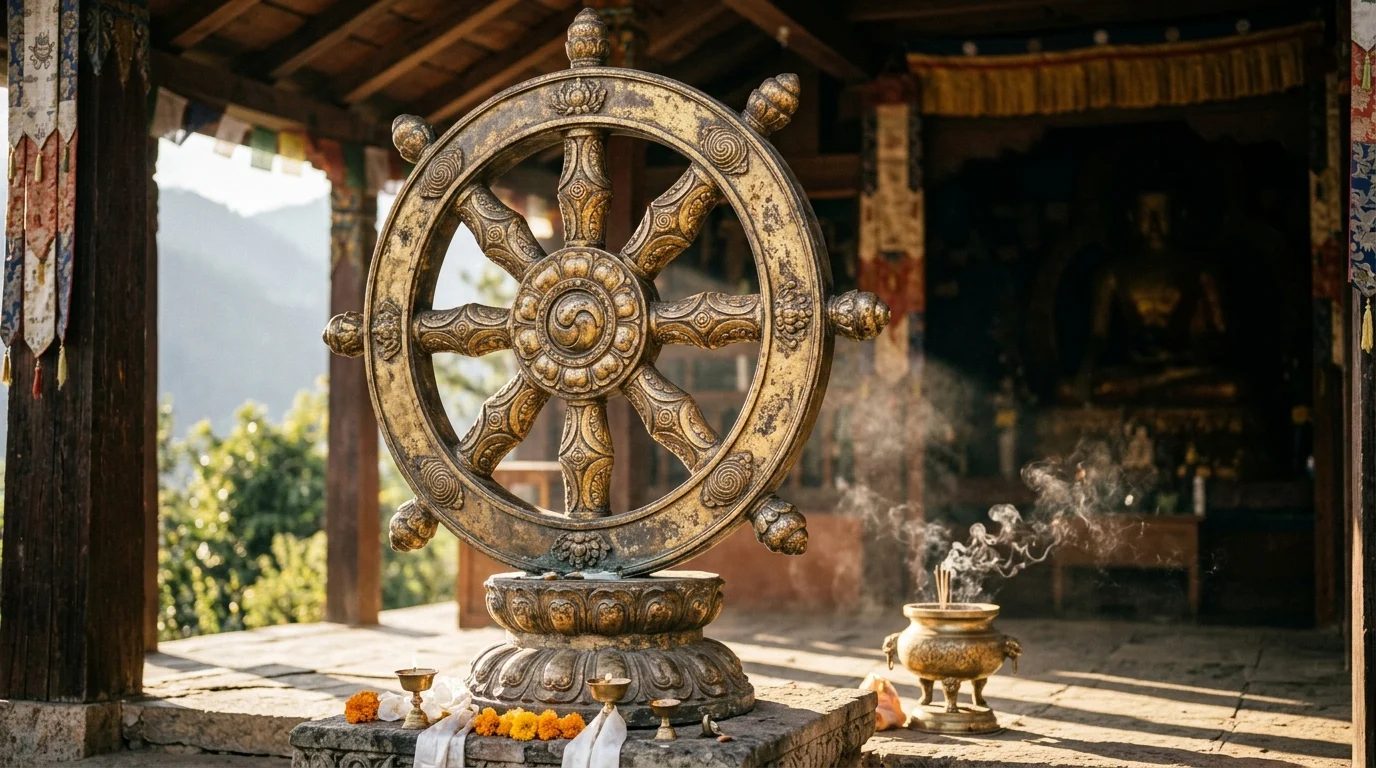
Karma wheel symbolism represents the continuous cycle of actions, consequences, personal growth, and spiritual transformation. It reminds us that every action can influence future experiences and that our choices shape the direction of our lives. Across different spiritual traditions, the karma wheel symbolizes the connection between cause and effect, the journey of the soul, and the opportunity to break free from repeated patterns.
The image of a turning wheel also represents life’s constant movement. Just as a wheel completes one cycle before beginning another, human experiences often follow patterns of learning, change, and renewal.
Understanding this symbol can offer valuable insights into personal responsibility, spiritual awareness, and the deeper meaning of life’s journey.
Karma Wheel Symbolism Meaning (Clear Definition)
Karma wheel symbolism refers to the spiritual representation of cause and effect, repeated life cycles, and the consequences of human actions. It illustrates how thoughts, intentions, and behaviors can influence present and future experiences.
The karma wheel is closely associated with the concept of samsara, which describes the cycle of birth, death, and rebirth in several Indian religious traditions.
Rather than representing punishment or reward alone, the wheel encourages people to understand the relationship between their actions and their consequences.
Its central meanings include:
- Cause and effect: Every intentional action can produce consequences.
- Life cycles: Experiences develop through continuous cycles of change.
- Spiritual growth: Challenges can provide opportunities for wisdom.
- Personal responsibility: Individuals should consider the effects of their choices.
- Rebirth: The wheel can represent repeated cycles of existence.
- Liberation: Spiritual traditions describe freedom from the cycle of rebirth as an important goal.
The turning wheel therefore represents a journey in which actions, experiences, and understanding remain deeply connected.
What Does Karma Wheel Symbolism Represent?
The karma wheel represents several important ideas about human existence and spiritual development. Its circular shape provides a powerful image of continuity, movement, and interconnected experiences.
Here are its most common symbolic interpretations.
1. The Cycle of Cause and Effect
The wheel represents the connection between actions and consequences. Positive intentions and harmful behavior can influence relationships, decisions, and future experiences in different ways.
It encourages people to think carefully before acting.
2. The Cycle of Life
A turning wheel symbolizes the natural movement of life. People experience beginnings, endings, challenges, and fresh opportunities throughout their journeys.
This interpretation reminds us that difficult periods do not necessarily last forever.
3. Rebirth and Renewal
In traditions that teach reincarnation, the karma wheel represents the repeated process of birth, death, and rebirth.
It symbolizes the continuation of existence until liberation from this cycle becomes possible.
4. Balance and Justice
The karma wheel can represent moral balance and accountability. It reminds people that their intentions and actions matter, even when consequences are not immediately visible.
5. Spiritual Awakening
The wheel also symbolizes growing awareness. As people understand their actions and motivations, they can develop greater compassion, patience, and wisdom.
| Symbolic element | Meaning |
|---|---|
| Circular shape | Continuity and life cycles |
| Turning motion | Change and transformation |
| Center of the wheel | Stability and spiritual awareness |
| Repeated cycles | Birth, death, and rebirth |
| Outer movement | Actions and their consequences |
| Breaking the cycle | Spiritual liberation |
Spiritual Meaning of Karma Wheel Symbolism
The spiritual meaning of karma wheel symbolism focuses on awareness, responsibility, and the journey toward liberation.
In Hinduism, Buddhism, and Jainism, karma plays an important role in understanding how actions influence the cycle of existence. However, each tradition explains karma and liberation in its own way.
Connection Between Actions and Spiritual Growth
The karma wheel teaches that spiritual development involves more than thoughts or beliefs. It also involves how people behave toward themselves and others.
Kindness, honesty, generosity, and compassion are valued because they reflect wholesome intentions and conduct.
Understanding Samsara
Samsara refers to the continuing cycle of birth, death, and rebirth.
The karma wheel is often used to represent this cycle, particularly in Buddhist traditions. It reminds followers that attachment, ignorance, and craving contribute to continued suffering.
The Path Toward Liberation
Many spiritual traditions describe liberation as freedom from the repeated cycle of existence.
In Buddhism, nirvana represents the ending of the causes of suffering and rebirth. In Hindu traditions, moksha refers to liberation from samsara.
The wheel therefore carries both a warning and a message of hope: people can develop greater understanding and move toward spiritual freedom.
Finding Inner Balance
On a personal level, the karma wheel can encourage people to examine their habits and intentions.
Instead of blaming circumstances for every difficulty, individuals can reflect on what they can change. This approach supports emotional maturity and more thoughtful decisions.
Biblical / Religious Meaning of Karma Wheel Symbolism
The karma wheel does not originate in the Bible or traditional Christian symbolism. Its roots belong primarily to Indian religious and philosophical traditions.
However, some of its themes can be compared with moral teachings found in other religions.
Karma in Hinduism
In Hindu philosophy, karma concerns actions and their consequences. It connects with dharma, the idea of duty and righteous living, as well as samsara and moksha.
The wheel can represent the continuing cycle of existence and the spiritual journey toward liberation.
Karma in Buddhism
In Buddhism, karma primarily concerns intentional actions and their consequences.
The Wheel of Life, commonly called the Bhavachakra, is an important Buddhist teaching image. It illustrates samsara, the causes of suffering, and the possibility of liberation through understanding and spiritual practice.
Karma in Jainism
Jainism teaches that karma affects the soul and contributes to its continued bondage within worldly existence.
The spiritual goal involves removing karmic influences through right faith, right knowledge, and right conduct.
Comparison With Biblical Teachings
Christianity does not teach karma in the same religious sense as Hinduism, Buddhism, or Jainism.
However, the Bible contains teachings about responsibility and consequences. Galatians 6:7 expresses the principle that people reap what they sow.
This offers a moral comparison, although it should not be confused with the traditional doctrine of karma or reincarnation.
Karma Wheel Symbolism in History and Culture
The karma wheel has deep historical connections with ancient Indian philosophy and religious traditions.
Its development reflects humanity’s long-standing interest in understanding existence, morality, suffering, and spiritual freedom.
Ancient Indian Traditions
Ideas about karma and rebirth developed in ancient Indian religious and philosophical thought.
Hindu, Buddhist, and Jain traditions explored how actions influence existence and how individuals might move beyond repeated cycles of suffering or worldly attachment.
The Buddhist Wheel of Life
The Wheel of Life Thangka Painting 75*50 -Samsara -Thangka
One of the best-known representations of the karma wheel is the Buddhist Bhavachakra, or Wheel of Life.
This traditional image often includes:
- Six realms of existence.
- The twelve links of dependent origination.
- The three poisons of ignorance, attachment, and aversion.
- A central symbolic structure showing the forces that maintain samsara.
- A figure representing impermanence, often holding the entire wheel.
The image serves as a visual teaching about suffering, attachment, karma, and liberation.
The Dharma Wheel
Dharma Wheel at the roof of Jokhang, Lhasa, Tibet
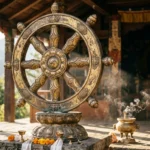
Another important Buddhist symbol is the Dharma Wheel, known as the Dharmachakra.
Its eight spokes commonly represent the Noble Eightfold Path, which teaches the way toward the cessation of suffering.
Although the Dharma Wheel and Wheel of Life are different symbols, both use the image of a wheel to communicate important spiritual teachings.
Cultural Interpretations
Today, the karma wheel appears in spiritual artwork, meditation spaces, religious illustrations, and educational materials.
Different communities interpret its meaning through their own beliefs, but its association with moral responsibility, transformation, and spiritual development remains important.
Karma Wheel Symbolism in Literature and Art
The karma wheel has inspired religious paintings, traditional artwork, philosophical writing, and modern creative expression.
Artists often use circular shapes and turning movements to communicate ideas that are difficult to explain through words alone.
The Wheel as a Symbol of Destiny
In literature, a wheel can represent the changing circumstances of human life.
Characters may experience success, failure, loss, and renewal as part of a larger journey. These experiences can resemble the continuous movement associated with karma.
The Wheel as a Symbol of Transformation
Artists sometimes use wheels to represent personal change and spiritual awakening.
A character who recognizes harmful patterns and chooses a different path may symbolize a movement toward greater awareness.
Religious Paintings and Mandalas
生死の輪タンクァアート、チベット仏教のマンダラ絵画 – ショップ Boudha Stupa Thanka Centre ウォールデコ・壁紙 – Pinkoi
Buddhist paintings frequently use circular arrangements to explain spiritual concepts.
The Bhavachakra is especially important because it transforms complex teachings about existence into a visual representation.
Mandalas also use circular patterns, although they have distinct meanings and purposes within different Buddhist and Hindu traditions.
Dream Meaning of Karma Wheel Symbolism
Dreaming about a karma wheel may symbolize repeated experiences, personal responsibility, unresolved situations, or a desire for change.
Dream interpretations are subjective and depend on personal experiences, emotions, and cultural beliefs. There is no scientific evidence that a dream predicts karmic consequences.
Here are some common symbolic interpretations.
Dreaming of a Turning Karma Wheel
A turning wheel may represent continuous change or a situation that keeps repeating in your life.
It can encourage you to recognize patterns and consider whether your current choices support your goals.
Dreaming of a Broken Karma Wheel
A broken wheel may symbolize the desire to end an unhealthy habit or move away from a difficult situation.
It can represent personal transformation and the possibility of beginning a different chapter.
Dreaming of a Golden Karma Wheel
A golden wheel may symbolize wisdom, spiritual understanding, hope, and personal growth.
Its interpretation may reflect your interest in finding greater meaning in life.
Dreaming of a Fast-Spinning Wheel
A rapidly turning wheel may represent uncertainty, pressure, or a feeling that life is moving too quickly.
Such a dream may invite you to slow down and reflect on your priorities.
Modern Meaning of Karma Wheel Symbolism
In modern culture, karma wheel symbolism often represents accountability, mindfulness, personal development, and the importance of making thoughtful decisions.
Many people use karma as a reminder to treat others fairly and avoid actions that create unnecessary harm.
Personal Responsibility
The karma wheel encourages people to recognize their influence on everyday situations.
For example, responding to an argument with patience rather than anger can help create a healthier relationship.
Breaking Negative Patterns
Repeated habits can produce repeated problems.
The wheel offers a useful metaphor for recognizing these patterns and making conscious changes.
Mindfulness and Self-Reflection
The symbol can inspire people to examine their thoughts, intentions, and behavior.
Regular reflection can help individuals understand their reactions and make more balanced choices.
Tattoos and Personal Expression
Buddhism wheel dharma Vector Images & Graphics for Commercial Use | VectorStock
Some people choose karma wheel tattoos to represent spiritual growth, balance, reincarnation, or the connection between actions and consequences.
For others, the design serves as a reminder to live responsibly and remain aware of their influence on the world.
Its meaning depends on the individual’s beliefs and personal experiences.
FAQS:
1. What Does the Karma Wheel Symbolize?
The karma wheel symbolizes cause and effect, repeated cycles of existence, spiritual growth, and personal responsibility. It reminds people that intentional actions can influence their experiences and future circumstances.
2. Is the Karma Wheel the Same as the Wheel of Life?
They are closely related but not always identical. The Buddhist Wheel of Life, or Bhavachakra, specifically illustrates samsara, its causes, and the path toward liberation.
3. What Does the Karma Wheel Mean Spiritually?
Spiritually, the karma wheel represents awareness, moral responsibility, transformation, and freedom from repeated cycles of suffering. It encourages people to develop wisdom and compassion.
4. What Is the Difference Between the Karma Wheel and the Dharma Wheel?
The Wheel of Life illustrates samsara and the causes of continued existence, while the Dharma Wheel represents the Buddha’s teachings and the path toward liberation.
5. Does the Karma Wheel Represent Reincarnation?
Yes, particularly in traditions that teach rebirth. It represents the continuing cycle of birth, death, and rebirth influenced by karma.
Conclusion
Karma wheel symbolism represents the powerful connection between actions, consequences, and the continuous journey of life. Rooted in ancient Indian spiritual traditions, it reminds us of the importance of awareness, compassion, and personal responsibility. Whether viewed as a religious teaching or a symbol of personal growth, the turning wheel encourages us to learn from our experiences, break harmful patterns, and move toward a more meaningful life.

I explore symbols, special characters, emojis, and their meanings, sharing simple, useful insights to help readers discover, understand, and creatively use symbols in everyday digital communication.