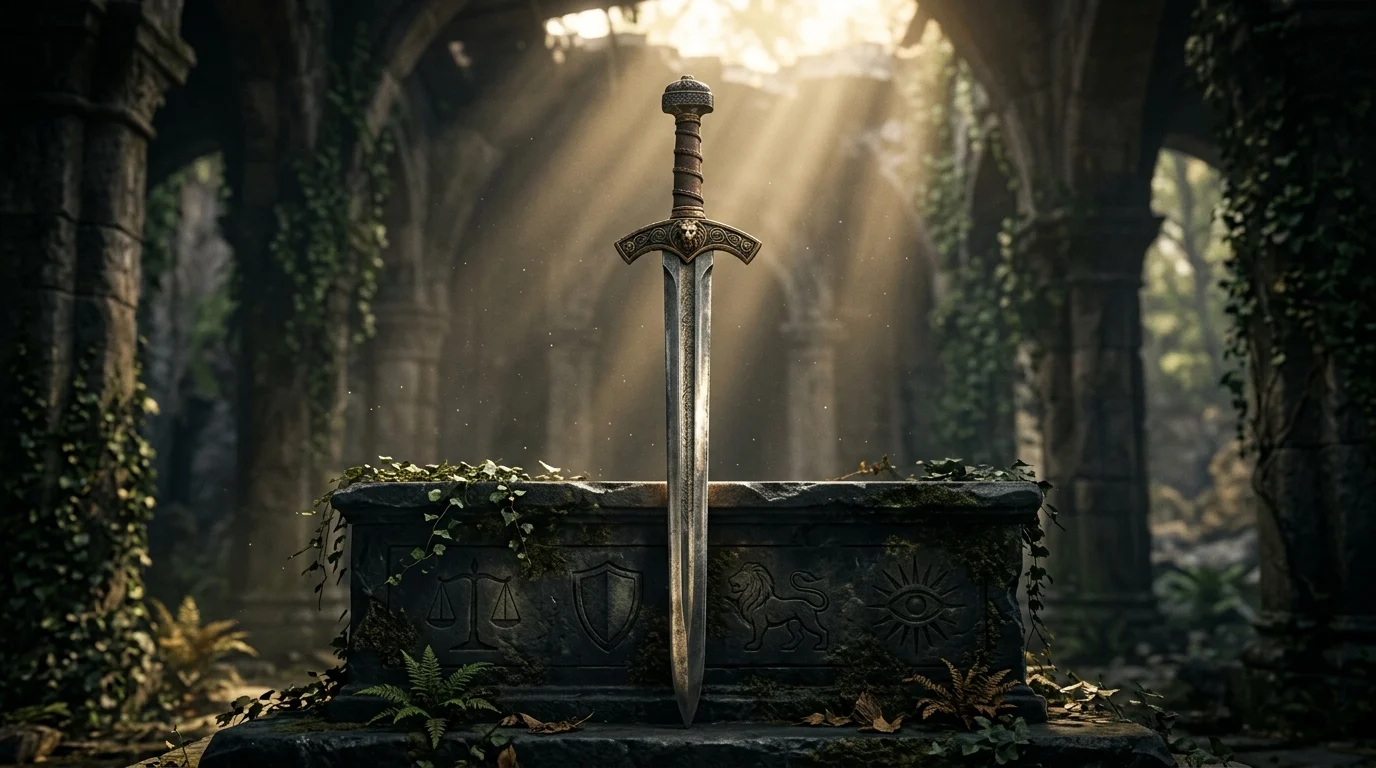
A sword is much more than a weapon. Throughout history, it has represented courage, justice, honor, protection, and the struggle between good and evil. From ancient legends to modern movies, sword symbolism continues to inspire people because it reflects some of humanity’s deepest values: strength, truth, sacrifice, and the desire to stand up for what is right.
The meaning of a sword can change depending on its cultural, spiritual, religious, or personal context. It may symbolize the power to defend others, the wisdom to make difficult decisions, or the courage to cut away negative influences.
Understanding sword symbolism helps reveal why this timeless object remains such a powerful image in mythology, literature, dreams, and everyday life.
Sword Symbolism Meaning (Clear Definition)
Sword symbolism refers to the symbolic representation of strength, courage, justice, protection, truth, and personal transformation through the image of a sword. Its meaning depends on the situation, tradition, and intention associated with it.
Historically, swords were tools of warfare and defense. Over time, they also became symbols of leadership, authority, spiritual discipline, and moral responsibility.
A sword can communicate two contrasting ideas. It can represent protection and the defense of justice, but it can also symbolize aggression, conflict, and destructive power.
Its sharp blade often suggests discernment: the ability to distinguish truth from falsehood, right from wrong, or what deserves to remain in your life from what must be released.
In many traditions, the sword is not simply a symbol of physical strength. It represents the responsibility that comes with power.
What Is the Main Symbolic Meaning of a Sword?
The most common symbolic meanings of a sword include:
- Strength: The ability to face adversity and remain resilient.
- Courage: The willingness to confront fear and uncertainty.
- Justice: The pursuit of fairness, truth, and accountability.
- Protection: The defense of oneself, loved ones, or important principles.
- Authority: Leadership, responsibility, and the right to make decisions.
- Wisdom: Clear judgment and the ability to separate truth from deception.
- Transformation: Ending an old chapter and making room for personal growth.
These meanings frequently overlap. For example, a sword held by a guardian may represent both courage and protection, while a sword used to divide two opposing forces may represent conflict or the need to make a decisive choice.
What Does Sword Symbolism Represent?
Sword symbolism represents several powerful human experiences, from defending personal values to overcoming internal struggles. Its interpretation often depends on who holds the sword, how it is used, and the circumstances surrounding it.
1. Strength and Courage
A sword is commonly associated with bravery because it has long been connected with warriors, soldiers, and heroic figures.
Symbolically, it represents the courage to confront difficult situations rather than avoid them. This does not necessarily mean fighting others. It may mean speaking honestly, establishing boundaries, or standing up for someone who cannot defend themselves.
A sword can remind us that genuine strength includes emotional resilience and the willingness to act despite fear.
2. Justice and Truth
The sword frequently represents justice, especially when paired with scales or other symbols of law.
Its sharp edge can symbolize the ability to expose deception and distinguish truth from falsehood. In this interpretation, the sword is a metaphor for clear judgment and decisive action.
However, justice and revenge are not the same. A sword associated with justice suggests responsibility and fairness, while one associated with revenge may represent anger or the desire to punish.
3. Protection and Defense
A sword can symbolize the determination to protect something valuable.
This may include family, personal freedom, spiritual beliefs, or emotional well-being. The protective meaning is especially strong in stories featuring guardians, knights, and heroic figures who defend vulnerable people.
On a personal level, this symbolism can encourage you to protect your time, maintain healthy boundaries, and remain committed to your principles.
4. Power and Authority
For centuries, swords have been associated with kings, rulers, military leaders, and people entrusted with responsibility.
A ceremonial sword may represent rank, honor, or the authority to lead. Yet this symbolism also carries a warning: power can be used to protect others or to control them.
The deeper lesson is that authority becomes meaningful when it is guided by wisdom, restraint, and accountability.
5. Sacrifice and Honor
In many historical traditions, a sword represented a commitment to duty, loyalty, and honor.
A warrior’s sword could symbolize a promise to protect a community or serve a cause greater than personal gain. In stories, a sword may also represent the sacrifices required to uphold one’s beliefs.
This interpretation connects sword symbolism with integrity: remaining faithful to your values even when doing so requires difficult choices.
6. Conflict and Separation
Because a sword can divide or sever, it may represent conflict, endings, and separation.
Symbolically, this could mean leaving a harmful situation, ending an unhealthy relationship, or making a decision that creates a clear distinction between the past and the future.
The image does not always indicate something negative. Sometimes, separation is necessary for growth.
Symbolic Meanings of Different Sword Images
| Sword image | Common symbolic meaning |
| Sword held upright | Courage, readiness, determination |
| Sword in a sheath | Restraint, peace, controlled power |
| Broken sword | Defeat, loss, reconciliation, or the end of conflict |
| Double-edged sword | Dual consequences, balanced power, difficult choices |
| Flaming sword | Divine authority, protection, judgment, or purification |
| Sword and scales | Justice, law, fairness, and accountability |
| Sword pointing downward | Mourning, surrender, peace, or the end of a struggle |
| Sword held by a guardian | Duty, loyalty, and protection |
These are common interpretations rather than universal rules. A sword’s meaning can change considerably across cultures, religions, and artistic traditions.
Spiritual Meaning of Sword Symbolism
The spiritual meaning of a sword often centers on inner strength, discernment, protection, and transformation. Rather than focusing exclusively on physical conflict, spiritual interpretations treat the sword as a representation of the mind, conscience, or commitment to a higher purpose.
The Sword as a Symbol of Inner Strength
Spiritually, a sword may represent the strength required to overcome fear, temptation, doubt, and destructive habits.
The battle in this interpretation takes place within the individual. The sword becomes a metaphor for the courage to acknowledge difficult truths and make choices that support personal growth.
For example, someone trying to overcome a harmful habit might view the sword as a reminder to remain disciplined and committed to change.
The Sword as a Symbol of Truth and Discernment
A sword’s sharp edge can symbolize clarity and the ability to recognize what is genuine.
This interpretation encourages people to question misleading beliefs, recognize unhealthy patterns, and distinguish meaningful guidance from manipulation.
The spiritual lesson is not to judge others harshly. Instead, it is to develop sound judgment while remaining humble enough to recognize personal mistakes.
The Sword as a Symbol of Spiritual Protection
In some spiritual traditions, swords represent protection against harmful forces or the defense of sacred principles.
In symbolic terms, this may mean preserving inner peace, resisting destructive influences, or remaining grounded during periods of uncertainty.
Specific interpretations vary between religious and cultural traditions, so sword symbolism should not be treated as having one universally accepted spiritual meaning.
The Sword as a Symbol of Transformation
A sword can also represent the decision to cut ties with patterns that no longer serve a meaningful purpose.
This might involve letting go of resentment, releasing limiting beliefs, or choosing a new direction after a difficult experience.
Its transformative message is simple: growth sometimes requires the courage to end something before beginning something new.
What Does a Sword Mean on a Personal Spiritual Journey?
If the image of a sword feels meaningful to you, consider what it brings to mind.
- Are you facing a decision that requires courage?
- Do you need to establish healthier boundaries?
- Are you searching for truth in a confusing situation?
- Is there a habit or belief you are ready to leave behind?
- Do you need to balance strength with compassion?
These questions offer a practical way to reflect on sword symbolism without assuming that the image carries a supernatural message.
Biblical and Religious Meaning of Sword Symbolism
Sword symbolism appears in several religious traditions, although its meaning differs depending on the text, deity, story, and cultural setting.
In religious contexts, the sword may represent divine judgment, spiritual struggle, truth, protection, or the consequences of moral choices.
Sword Symbolism in the Bible
The Bible uses the image of a sword in both literal and figurative ways.
In some passages, the sword represents warfare, judgment, or the consequences of human actions. In others, it becomes a metaphor for the power of God’s word and the spiritual challenges faced by believers.
One important example appears in Ephesians 6:17, which describes the word of God as the “sword of the Spirit.” In the passage’s broader context, this imagery forms part of the armor of God, a metaphor for spiritual readiness and faithfulness.
The sword here represents spiritual truth and the ability to stand firm in faith.
Hebrews 4:12 also compares the word of God to a sharp, double-edged sword. The image emphasizes its penetrating power to reveal thoughts, intentions, and the inner condition of the heart.
These passages illustrate that biblical sword symbolism is not limited to physical violence. It can also communicate discernment, conviction, and spiritual authority.
The Flaming Sword in Genesis
In Genesis 3:24, a flaming sword appears in the account of the Garden of Eden. It is associated with the cherubim and the guarding of the way to the tree of life after Adam and Eve are expelled from the garden.
In this context, the flaming sword symbolizes the boundary protecting sacred space and the consequences of humanity’s separation from Eden.
The passage is often interpreted in relation to divine authority, judgment, and the restricted access to the tree of life.
The Sword of Simeon in Luke
In Luke 2:34–35, Simeon tells Mary that a sword will pierce her soul.
This is generally understood as a metaphor for profound sorrow and suffering associated with Jesus’ life and mission. It demonstrates that a sword can symbolize emotional pain rather than physical injury.
This interpretation is especially significant because it connects the sword with love, sacrifice, and the personal cost of witnessing suffering.
Sword Symbolism in Other Religious Traditions
Sword imagery also appears in other religious and philosophical traditions.
In Hindu traditions, divine weapons can symbolize the power to overcome ignorance, disorder, or harmful forces. The sword associated with the goddess Durga, for example, is often interpreted as a representation of the destruction of evil and the restoration of balance.
In Buddhist art, the flaming sword associated with Manjushri, the bodhisattva of wisdom, symbolizes the cutting through of ignorance and delusion.
In Islamic history and artistic traditions, swords can carry associations with leadership, courage, defense, and historical identity. Interpretations depend on the specific historical, religious, and cultural context.
Across these traditions, the sword may symbolize a struggle against ignorance or injustice, but the details differ. It is important to understand each symbol within its own tradition rather than assuming that all religions interpret it identically.
Sword Symbolism in History and Culture
Sword symbolism developed over centuries as swords became associated with warfare, social status, leadership, law, and ceremonial traditions.
Although the sword began primarily as a practical weapon, its cultural importance eventually extended far beyond the battlefield.
Ancient Civilizations and the Sword
In ancient societies, swords were closely linked with military power and social standing.
In ancient Rome, military equipment could communicate a soldier’s role and status. In various ancient Mediterranean and Near Eastern societies, weapons also appeared in royal imagery and ceremonial settings.
In ancient China, the jian, a straight double-edged sword, developed associations with martial discipline, refinement, and, in some literary and philosophical traditions, the cultivated warrior.
These examples demonstrate that sword symbolism was never limited to aggression. Weapons could also communicate identity, discipline, and social responsibility.
Medieval Knights and Chivalry
During the European Middle Ages, swords became closely associated with knights, noble status, and ideals of chivalry.
Ceremonial sword presentations could mark the conferral of knighthood, while stories about heroic warriors emphasized loyalty, bravery, and the defense of the vulnerable.
The sword became a powerful emblem of the ideal knight, even though historical warfare and the behavior of actual knights were often more complicated than romantic legends suggested.
In this cultural setting, sword symbolism combined physical capability with moral expectations.
Japanese Samurai and the Katana
The Japanese katana is strongly associated with the samurai and their historical role in Japanese society.
Beyond its function as a weapon, the sword became an important marker of status, identity, craftsmanship, and martial tradition.
Modern popular culture often connects the katana with the samurai ideal of discipline and honor. However, the relationship between swords, samurai ethics, and concepts such as bushido changed over time and should not be reduced to a single timeless code.
The katana’s cultural significance reflects both its historical use and the traditions, stories, and artistic practices that developed around it.
Legendary Swords and Their Meanings
Legendary swords remain among the most recognizable symbols of authority and destiny.
- Excalibur: The legendary sword associated with King Arthur often represents rightful kingship, leadership, and the responsibilities of power.
- The Sword of Damocles: This story’s sword hanging overhead symbolizes the constant danger and anxiety that can accompany power and privilege.
- The Sword of Gryffindor: In the Harry Potter stories, the sword is associated with bravery, worthiness, and the qualities of a true Gryffindor.
- The Kusanagi-no-Tsurugi: This legendary Japanese sword is associated with imperial regalia and the traditions surrounding Japan’s imperial heritage.
These examples reveal how swords become more than objects. They can embody the legitimacy of a ruler, the risks of authority, or the qualities required to meet a challenge.
Sword Symbolism in Literature and Art
In literature and visual art, a sword often acts as a compact symbol that communicates a character’s values, conflicts, or destiny.
Its meaning depends on how the artist or author presents it. A sword may be a sign of heroism in one story and a warning about destructive ambition in another.
The Sword as a Hero’s Journey
In traditional tales, the hero’s sword often represents readiness for a major challenge.
Receiving a sword can mark the beginning of a quest, while discovering a legendary weapon may signal that a character has been chosen for an important responsibility.
The sword can also reflect the hero’s development. At the beginning of a story, it may represent physical strength; by the end, it may symbolize wisdom, self-control, or the willingness to protect others.
The Sword as a Symbol of Justice
Writers and artists frequently use swords to represent law, judgment, and moral authority.
A sword held by a judge-like figure or paired with scales suggests the power to enforce rules and defend fairness.
However, artists may also use the same imagery ironically. A sword that appears to represent justice may expose corruption when its wielder uses power for personal gain.
This contrast allows the sword to communicate both the promise and the danger of authority.
The Sword as a Symbol of Conflict
In fiction, a sword can represent external battles and internal struggles.
A duel might dramatize a conflict between rival characters, while a sword left unused may suggest restraint or the possibility of reconciliation.
A broken sword can symbolize defeat, the end of an old identity, or a rejection of violence. Its interpretation depends on the surrounding story.
The Sword in Paintings and Sculptures
In visual art, the sword’s position often changes its meaning.
An upright sword may suggest vigilance or readiness. A sheathed sword can communicate peace or controlled strength. A downward-pointing sword may convey mourning, submission, or the end of a struggle.
The figure holding the sword also matters. In the hands of a protector, it may represent responsibility. In the hands of a tyrant, it may symbolize oppression.
By considering the sword’s placement, the identity of its holder, and the surrounding imagery, viewers can better understand the message of an artwork.
Dream Meaning of Sword Symbolism
Dreams involving swords can be interpreted as reflections of personal concerns, emotions, conflicts, or decisions. There is no scientifically established universal meaning for a sword in a dream, and a dream should not automatically be treated as a prediction of future events.
Its personal meaning may depend on what happened in the dream and how you felt during it.
Dreaming of Holding a Sword
Holding a sword may reflect a desire to feel stronger, more confident, or better prepared for a challenge.
It might also relate to a situation in which you feel responsible for defending your values or making a difficult decision.
Consider whether you felt confident, afraid, angry, or calm while holding it. Your emotional response may offer more useful insight than the image alone.
Dreaming of Fighting With a Sword
A sword fight may reflect tension, competition, or a disagreement in your waking life.
If you are struggling with someone, the dream might provide an opportunity to examine your feelings about the conflict. It does not necessarily mean that a real confrontation will occur.
The dream may also represent an internal struggle between competing priorities.
Dreaming of a Broken Sword
A broken sword may symbolize frustration, disappointment, or a perceived loss of confidence.
Alternatively, it could represent the desire to end a conflict or abandon an approach that is no longer helping you.
Ask yourself whether something in your life feels unfinished, ineffective, or ready to change.
Dreaming of Finding a Sword
Finding a sword may reflect the discovery of personal strengths, a renewed sense of confidence, or a growing willingness to take responsibility.
It could also represent the realization that you have more options than you previously believed.
Rather than viewing the dream as a definite sign of destiny, consider whether it connects with a new opportunity or decision in your life.
Dreaming of Being Threatened by a Sword
A threatening sword may reflect feelings of vulnerability, pressure, or fear of confrontation.
It might relate to a difficult relationship, workplace tension, or a situation in which you feel that your choices are limited.
If the dream is recurring or distressing, paying attention to current stressors and sleep quality may be more helpful than searching for a fixed symbolic interpretation.
Modern Meaning of Sword Symbolism
Today, sword symbolism continues to appear in fashion, tattoos, jewelry, personal art, entertainment, and popular culture.
Its modern meaning often combines traditional associations with contemporary ideas about identity, resilience, self-expression, and personal growth.
Sword Tattoos and Personal Identity
A sword tattoo can represent different values depending on the design and the person’s reasons for choosing it.
Common interpretations include:
- Strength and resilience: Overcoming difficult experiences and continuing forward.
- Protection: Defending loved ones, personal boundaries, or deeply held beliefs.
- Justice: Standing up for fairness and accountability.
- Independence: Taking control of one’s decisions and direction.
- Transformation: Ending an old chapter and embracing a new identity.
- Honor and loyalty: Remaining committed to personal principles or important relationships.
Additional elements can influence the design’s meaning. A sword combined with flowers may suggest the balance between strength and gentleness, while a sword surrounded by flames may communicate intensity, purification, or determination.
These interpretations are not universal. The most meaningful tattoo is one whose symbolism reflects the wearer’s own values and experiences.
Sword Jewelry and Decorative Objects
Sword pendants, rings, and decorative swords often serve as personal emblems rather than practical weapons.
A small sword pendant might represent courage or determination, while a decorative sword displayed in a home may reflect an interest in history, craftsmanship, or martial traditions.
In some contexts, a sword-shaped gift can communicate admiration for someone’s strength or respect for their sense of duty.
The meaning depends on the occasion, design, and relationship between the people involved.
The Sword in Movies, Games, and Fantasy
Modern entertainment frequently uses swords as visual shorthand for heroism, power, and destiny.
In fantasy films and video games, a legendary sword may grant a character new abilities or represent a challenge that must be overcome. Its power may depend on the character’s integrity, courage, or willingness to make sacrifices.
Other stories deliberately challenge this heroic image. A powerful sword may corrupt its owner or reveal the destructive consequences of seeking control.
This contrast reinforces one of the oldest ideas in sword symbolism: possessing power is less important than knowing how to use it.
Sword Symbolism in Everyday Life
You do not need to own a sword or follow a particular spiritual tradition to find meaning in its symbolism.
The sword can serve as a reminder to:
- Speak honestly, even when the truth is uncomfortable.
- Set boundaries without becoming unnecessarily aggressive.
- Protect what matters without trying to control everything.
- Make difficult decisions with care and confidence.
- Use personal strength responsibly.
- Recognize when a conflict should be resolved rather than continued.
These lessons make the sword a relevant symbol of modern personal development.
Its message is not simply to become stronger. It is to develop the judgment to know when strength is needed, when restraint is wiser, and when it is time to move forward.
Frequently Asked Questions About Sword Symbolism
1. What does a sword symbolize spiritually?
A sword often symbolizes inner strength, spiritual protection, truth, discernment, and the ability to overcome ignorance or negative influences. Its precise meaning depends on the spiritual tradition and personal context.
2. Is a sword a symbol of good luck?
A sword is not universally recognized as a good-luck symbol, but some people associate it with protection, courage, success, or overcoming obstacles. Its significance depends on cultural beliefs and individual interpretation.
3. What does a double-edged sword symbolize?
A double-edged sword commonly represents dual consequences, the complexity of power, or a situation that can produce both benefits and harm. The expression “a double-edged sword” is often used for something that offers an advantage while also creating a disadvantage.
4. What does a sword symbolize in the Bible?
In the Bible, a sword can represent warfare, judgment, and suffering, but it can also symbolize spiritual truth. Ephesians 6:17 describes the word of God as the sword of the Spirit, while Hebrews 4:12 uses a double-edged sword as an image of its penetrating power.
5. What does it mean to dream about a sword?
Dreaming about a sword may reflect courage, conflict, personal boundaries, or a difficult decision. Dream meanings are subjective, so it is best to consider the dream’s emotional tone and its possible connection to your current experiences.
Conclusion: The Deeper Meaning of Sword Symbolism
Sword symbolism has endured because it captures the relationship between strength and responsibility. Across history, religion, literature, and modern culture, the sword has represented courage, justice, protection, truth, sacrifice, and transformation.
Yet its deepest lesson lies in the way power is used. A sword can defend what is valuable or cause unnecessary harm; it can represent wise action or uncontrolled aggression.
Ultimately, the sword reminds us that true strength is not measured only by the ability to fight. It is also found in the wisdom to choose our battles, the courage to stand by our principles, and the restraint to use our power with purpose.

I explore symbols, special characters, emojis, and their meanings, sharing simple, useful insights to help readers discover, understand, and creatively use symbols in everyday digital communication.