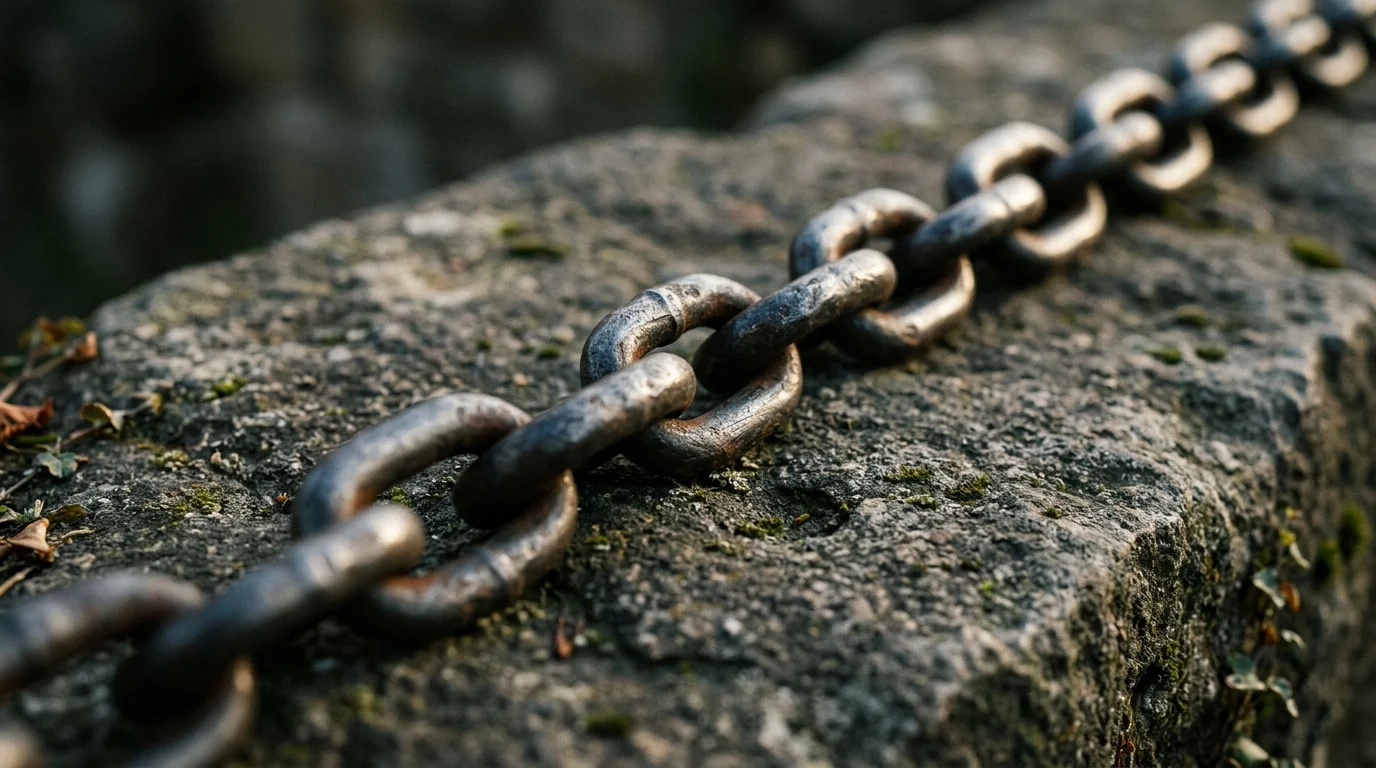
Chains are powerful symbols that can represent connection, loyalty, strength, unity, restriction, or freedom. Their meaning often depends on how they appear, the material they are made from, and the emotions they evoke. In chain symbolism, the same object can represent a loving bond in one situation and an unwanted burden in another.
Throughout history, chains have carried deep meanings in religion, literature, art, relationships, and everyday life. They can remind us of the people who connect us, the responsibilities we carry, and the invisible limitations we may need to overcome.
Understanding chain symbolism helps reveal why this familiar object continues to hold emotional, spiritual, and cultural significance.
Chain Symbolism Meaning (Clear Definition)
Chain symbolism refers to the meanings associated with chains, including connection, unity, strength, loyalty, bondage, control, and liberation. A chain may represent something that holds people together or something that prevents them from moving forward.
The interpretation depends on the context. A strong, unbroken chain may symbolize lasting relationships and resilience, while a broken chain often represents independence, release, and a new beginning.
Chains can carry positive and negative meanings simultaneously. They may remind us that meaningful relationships create bonds, but they can also show how obligations, fear, or unhealthy attachments restrict personal growth.
For example, a family heirloom chain might represent love and continuity across generations. In contrast, a heavy chain wrapped around someone’s wrists might represent oppression or a loss of freedom.
Common Symbolic Meanings of Chains
| Chain Symbol | Common Meaning | Possible Interpretation |
| Unbroken chain | Unity and strength | A lasting bond or shared purpose |
| Broken chain | Freedom and release | Overcoming limitations or leaving the past behind |
| Heavy chain | Burden and responsibility | Emotional pressure or difficult obligations |
| Golden chain | Wealth and status | Success, prestige, or material attachment |
| Silver chain | Elegance and connection | Personal identity, affection, or commitment |
| Interlocking links | Cooperation and unity | Different people working toward a common goal |
| Rusty chain | Neglect or the past | An outdated attachment or unresolved issue |
| Chain around the hands | Restriction and control | Feeling powerless or trapped |
| Chain being unlocked | Opportunity and liberation | Discovering a way forward |
These meanings are interpretive rather than universal. A chain’s significance can change depending on personal experiences, cultural traditions, and the situation in which it appears.
What Does Chain Symbolism Represent?
Chain symbolism can express several important themes in human life. Some meanings focus on the relationships that give us strength, while others highlight the obstacles that keep us from reaching our potential.
1. Connection and Relationships
Each link in a chain depends on the links around it. This makes chains natural symbols of friendship, family, partnership, and community.
In relationships, a chain can represent the ties that unite people through affection, trust, shared memories, and mutual responsibility. It can also symbolize the connection between generations, showing how values and traditions pass from one person to another.
However, healthy connection should not require the loss of individuality. A meaningful bond allows people to support each other while maintaining their independence.
2. Strength and Resilience
A chain is designed to withstand tension, making it a symbol of endurance and resilience.
The strength of a chain depends on its links and how they are joined. Symbolically, this suggests that people become stronger through cooperation, preparation, and mutual support.
A chain can therefore represent the courage to face hardship without giving up. It reminds us that strength does not always come from standing alone; sometimes, it comes from knowing who stands beside us.
3. Bondage and Restriction
Chains have historically been used to restrain people, animals, and objects. As a result, they can symbolize captivity, oppression, dependence, and a lack of control.
In everyday life, people may use the expression “being chained” to describe feeling trapped by debt, fear, unhealthy relationships, demanding expectations, or difficult circumstances.
In this context, chain symbolism invites reflection. It encourages us to identify which responsibilities are meaningful and which limitations may be preventing us from growing.
4. Freedom and Liberation
A broken chain is one of the clearest symbols of liberation.
It may represent escaping oppression, ending a harmful relationship, overcoming addiction, rejecting unfair expectations, or reclaiming personal independence.
Freedom does not always mean leaving everything behind. Sometimes, it means changing a habit, establishing healthier boundaries, or finding the courage to make a different choice.
5. Loyalty and Commitment
Chains can also symbolize promises that connect people over time. A necklace chain given as a gift, for example, may represent affection, remembrance, or a lasting commitment.
In this sense, the chain becomes a physical reminder of an emotional bond. Its value may come less from its material and more from the memories and intentions attached to it.
6. Responsibility and Consequences
A chain can symbolize the way one action connects to another. Every link contributes to the structure, just as individual decisions can influence families, communities, and future opportunities.
This interpretation emphasizes accountability. Our choices can create lasting connections, but they can also establish patterns that become difficult to change.
Recognizing these connections can help us make more thoughtful decisions and take responsibility for the direction of our lives.
Spiritual Meaning of Chain Symbolism
The spiritual meaning of chains often centers on the relationship between attachment and freedom. A chain may represent a sacred connection, a personal commitment, an emotional burden, or an opportunity to release what no longer serves us.
Spiritual interpretations vary among individuals and traditions. There is no single universal meaning, but several recurring themes appear across symbolic interpretations.
Chains as Symbols of Spiritual Connection
An unbroken chain can represent a connection to family, ancestors, a faith community, or a larger spiritual purpose.
Its linked structure suggests that individual lives may be part of something greater. People can influence one another through kindness, shared beliefs, inherited wisdom, and acts of service.
For someone who values spiritual continuity, a chain may serve as a reminder that personal identity is shaped partly by the relationships and traditions that came before them.
Chains as Emotional or Spiritual Burdens
In spiritual reflection, chains sometimes represent attachments that make inner peace difficult to achieve.
These might include resentment, guilt, jealousy, fear, or a persistent need for approval. Such feelings can become restrictive when they dominate a person’s decisions or prevent emotional healing.
The symbol does not mean that every attachment is harmful. Love, responsibility, and community can be deeply meaningful. The important distinction is whether a bond supports growth or creates lasting distress.
Breaking Chains as Personal Transformation
Breaking a chain can symbolize the decision to move beyond old patterns.
This may involve forgiving someone, changing destructive habits, setting boundaries, or releasing expectations that no longer reflect one’s values.
The process is not always immediate. Personal transformation often requires patience, honest self-reflection, and practical action.
A broken chain can therefore serve as a reminder that the past may shape us without having to determine our future.
Seeing a Chain as a Spiritual Sign
Some people interpret seeing a chain repeatedly as a prompt to reflect on relationships, responsibilities, or freedom. Others simply recognize it as an ordinary object whose meaning depends on their circumstances.
Rather than treating a chain as a definite prediction or supernatural message, consider what it brings to mind. Ask yourself whether you feel supported, restricted, committed, or ready for change.
The most useful interpretation is one that encourages thoughtful choices rather than fear or unquestioning belief.
Biblical / Religious Meaning of Chain Symbolism
In biblical literature, chains often represent imprisonment, suffering, restraint, and the power of oppressive circumstances. However, chains can also appear in narratives of faith, endurance, divine assistance, and release from captivity.
Their meaning depends on the passage and its historical setting.
Chains in the Bible
Chains appear in several biblical accounts involving imprisonment and deliverance.
In Acts 12:6–7, Peter is imprisoned and bound with chains when an angel appears, and his chains fall away. The episode connects chains with captivity while presenting their removal as a dramatic act of deliverance.
In Acts 16:25–26, Paul and Silas pray and sing hymns while imprisoned. An earthquake shakes the prison, and the prisoners’ bonds are loosened. This account emphasizes faith and hope in difficult circumstances.
In these narratives, chains are not inherently evil objects. Rather, they represent physical restraint within stories that explore suffering, perseverance, faith, and freedom.
Chains as Symbols of Bondage and Deliverance
Biblical references to chains can be understood through two contrasting ideas:
- Bondage: Chains represent imprisonment, oppression, or circumstances that limit freedom.
- Deliverance: The removal of chains represents release, restoration, or the overcoming of confinement.
These themes have influenced religious art, sermons, hymns, and spiritual language. Expressions such as “breaking chains” are frequently used to describe overcoming sin, destructive behavior, fear, or other forms of spiritual bondage.
Such interpretations should be understood within the relevant theological tradition rather than treated as a single meaning shared by every religious community.
Chains in Other Religious and Cultural Traditions
Outside Christianity, chains may be interpreted through cultural practices, historical experiences, or personal spiritual beliefs. They can represent obligation, discipline, interconnectedness, captivity, or the consequences of one’s actions.
There is no universal religious rule that assigns the same spiritual meaning to every chain. Understanding the tradition in which a symbol appears is essential to interpreting it respectfully and accurately.
Chain Symbolism in History and Culture
Chains have played an important role in human history, serving practical purposes while developing powerful cultural associations. They have been used in transportation, construction, jewelry, maritime work, and systems of imprisonment.
Because chains can connect or restrain, their cultural meaning often reflects the circumstances in which they are used.
Chains in Ancient Civilizations
In ancient societies, chains and linked metal objects served functional and decorative purposes. Metalworking made it possible to create chains for securing objects, lifting loads, and producing jewelry.
Decorative chains could communicate wealth, rank, or social position. Precious metals and elaborate craftsmanship made certain chain ornaments symbols of prestige and distinction.
Over time, the chain became more than a practical object. Its linked structure offered a visible representation of continuity, attachment, and strength.
Chains and Slavery
One of the most painful historical associations of chains is slavery and forced confinement.
Chains were used to restrain enslaved people and prisoners, making them powerful symbols of human suffering, exploitation, and the denial of freedom.
Today, chains in memorials, historical displays, literature, and public art can serve as reminders of these injustices. A broken chain may represent emancipation, resistance, and the continuing struggle for human dignity.
This historical context matters because chain symbolism is not always an abstract metaphor. For many communities, it is connected to real experiences of oppression and liberation.
Chains in Maritime Culture
Chains have long been associated with ships, anchors, and maritime work. An anchor chain physically connects a vessel to its anchor, helping secure it in place.
This practical function has encouraged symbolic associations with stability, security, endurance, and belonging.
A chain connected to an anchor may suggest staying grounded during uncertainty. At the same time, a chain can imply being held in one place when movement or change is desired.
Chains as Symbols of Unity
Linked chains have also become recognizable symbols of collective action and solidarity.
When individuals or groups join hands, they can form a human chain to express cooperation, remembrance, or support for a cause. In this context, each participant contributes to a larger structure that no individual could create alone.
The symbol communicates a simple idea: collective strength grows when people work together.
Chain Symbolism in Literature and Art
Writers and artists frequently use chains to explore freedom, identity, power, love, and human vulnerability. Their visual simplicity makes them effective symbols that audiences can understand without lengthy explanations.
Chains in Literature
In literature, chains often represent invisible forces that shape a character’s life.
A character may be chained by poverty, family expectations, guilt, social class, prejudice, or a painful memory. Although these restrictions may not be physical, they can influence decisions as strongly as actual restraints.
Chains can also represent loyalty and commitment. A character who remains connected to family or community despite hardship may embody the positive side of the symbol.
The most interesting literary uses often involve both meanings at once. A relationship can provide emotional security while limiting personal independence, creating a conflict between belonging and freedom.
Chains in Visual Art
<AsyncImageGroup query={[“broken iron chain links dark dramatic photography symbolism freedom”,”interlocking metal chain close up artistic photography unity”,”gold chain necklace elegant still life photography”,”heavy rusted iron chains historical texture photography”]} aspectRatio=”5:4″ layout=”bento” size=”lg”/>
Artists can change the meaning of a chain through its appearance, placement, and surrounding imagery.
- Broken chains: Often communicate liberation, resistance, or a turning point.
- Interlocked chains: Suggest unity, cooperation, and shared responsibility.
- Rusty chains: May evoke neglect, age, decay, or unresolved history.
- Heavy chains: Can suggest oppression, hardship, or overwhelming obligations.
- Decorative gold chains: May represent luxury, status, attraction, or material desire.
A chain surrounding a flower, for example, might contrast beauty with restriction. A broken chain lying beside an open door could suggest that a new opportunity has become possible.
The meaning comes not only from the chain itself but also from the visual relationship between the object and its surroundings.
Chains as Metaphors for Human Experience
Chain imagery works especially well because it makes abstract feelings visible.
Anxiety can feel like a chain that restricts movement. A supportive community can resemble a chain that becomes stronger through cooperation. A painful memory can feel like a link connecting the present to the past.
These metaphors help readers and viewers understand complex emotions through a familiar physical object.
Dream Meaning of Chain Symbolism
Dreams involving chains can be interpreted in different ways, depending on the dreamer’s emotions, personal experiences, and the events taking place in the dream.
There is no scientifically established universal meaning for dreaming about chains. Dreams may reflect ordinary memories, stress, emotional concerns, or personal associations rather than predict future events.
Nevertheless, considering the imagery can be a useful starting point for self-reflection.
Dreaming of Being Bound by Chains
Being restrained by chains in a dream may reflect a feeling of limited control or personal freedom.
You might be dealing with a demanding responsibility, a difficult relationship, financial pressure, or a situation in which your choices seem restricted.
Consider whether something in your waking life makes you feel unable to move forward. The dream may provide an opportunity to examine that feeling without assuming it has a supernatural cause.
Dreaming of Breaking a Chain
Breaking a chain may symbolize a desire for independence, change, or relief from pressure.
It could reflect your readiness to leave behind an unhelpful habit, challenge an expectation, or make a decision that supports your well-being.
If the dream brings a sense of relief, that emotion may be particularly useful to explore.
Dreaming of a Golden Chain
A golden chain may bring to mind success, affection, wealth, recognition, or commitment.
However, gold can also symbolize the attraction of material possessions or the responsibilities that accompany success. The dream’s emotional atmosphere can help you decide which interpretation feels most relevant.
Dreaming of a Broken or Rusty Chain
A broken chain may suggest separation, change, or the ending of an attachment. A rusty chain might evoke something neglected, outdated, or difficult to revisit.
Neither image necessarily signals a bad event. Personal associations are more useful than treating dream symbols as fixed predictions.
How to Interpret a Chain Dream
If you dream about chains, ask yourself three questions:
- What was the chain doing, and was it holding something together or keeping something restrained?
- How did you feel in the dream: safe, anxious, trapped, relieved, or powerful?
- Does the image remind you of a current relationship, responsibility, memory, or decision?
Your answers can help you explore the dream’s personal significance without relying on rigid interpretations.
Modern Meaning of Chain Symbolism
In modern life, chain symbolism appears in jewelry, fashion, activism, popular culture, tattoos, and everyday language. Its meanings continue to evolve while retaining the central tension between connection and restriction.
Chain Jewelry and Personal Identity
Chain necklaces, bracelets, and other accessories can represent style, identity, affection, or personal milestones.
Some people wear a chain because it was given by a loved one. Others choose one as a reminder of an achievement, a meaningful period in their lives, or a commitment they want to honor.
The type of chain may also influence its visual impression. A delicate chain can appear elegant and understated, while a thick metal chain may communicate boldness, confidence, or strength.
Ultimately, jewelry symbolism is personal. The same piece can mean something different to its wearer and to an observer.
Broken Chain Tattoos
<AsyncImage query=”minimalist broken chain tattoo design black ink forearm symbolic freedom” aspectRatio=”5:4″ width=”100%”/>
A broken chain tattoo is commonly associated with overcoming adversity, reclaiming independence, and refusing to remain defined by past limitations.
People may choose this design to commemorate a personal transformation, a difficult period they have survived, or a commitment to living more freely.
Others use chain tattoos to represent solidarity, loyalty, or a bond that has endured hardship. The meaning depends on the design and the story behind it.
Chains in Fashion and Popular Culture
Chains have become prominent accessories in streetwear, luxury fashion, music, and performance. Their appearance can communicate confidence, rebellion, wealth, individuality, or affiliation with a particular aesthetic.
In these settings, chains may be decorative rather than deeply symbolic. Nevertheless, fashion often borrows meaning from cultural history, allowing an ordinary accessory to express identity and attitude.
It is also important to recognize that chain imagery associated with oppression can carry painful historical implications. Context and cultural awareness influence how a design is understood.
Chains in Activism and Social Movements
Chains and broken-chain imagery are frequently used to communicate resistance to oppression and the pursuit of freedom.
A broken chain can represent rejecting discrimination, challenging unjust systems, or standing with people whose rights have been denied. A human chain can express peaceful solidarity and collective responsibility.
These images are effective because they make an abstract social goal visible: removing restraints and creating conditions in which people can live with greater dignity.
The Personal Meaning of Chains Today
In a fast-changing world, chains can represent the connections that help people remain grounded, as well as the habits and expectations they may need to reconsider.
They can remind us to value commitment without confusing it with control, to appreciate community without losing individuality, and to recognize when responsibility becomes an unhealthy burden.
This balance is central to the modern interpretation of chain symbolism.
Frequently Asked Questions About Chain Symbolism
What does a chain symbolize spiritually?
Spiritually, a chain may represent connection, commitment, responsibility, or attachment. A broken chain is often interpreted as a symbol of liberation, transformation, or release from restrictive patterns.
What does a broken chain symbolize?
A broken chain commonly symbolizes freedom, independence, resistance, and overcoming obstacles. Its precise meaning depends on the situation and the person interpreting it.
Are chains a symbol of love and loyalty?
Yes, chains can represent lasting affection, loyalty, and the bonds between loved ones. A chain given as a gift may serve as a reminder of a meaningful relationship or shared commitment.
What does dreaming about chains mean?
Dreaming about chains may reflect feelings of restriction, responsibility, attachment, or a desire for freedom. Dream interpretations are subjective, so personal emotions and circumstances are more useful than assuming a dream predicts the future.
What does a chain tattoo mean?
A chain tattoo may represent strength, loyalty, unity, resilience, or personal commitment. A broken chain design more often emphasizes freedom, independence, and overcoming adversity.
Conclusion: The Deeper Meaning of Chain Symbolism
Chain symbolism reminds us that the bonds in our lives can both support and restrict us. Chains can represent love, loyalty, resilience, and unity, but they can also reveal the weight of unhealthy attachments, unfair expectations, and lost freedom.
Their deepest meaning often lies in the difference between a connection we choose and a limitation we struggle to escape.
By understanding this contrast, we can appreciate the relationships that strengthen us while finding the courage to release what holds us back. Sometimes, the strongest link is the one that connects us to others; at other times, the bravest act is breaking free.

I explore the meanings, history, and cultural significance behind symbols, helping readers understand how symbols connect with ideas, emotions, traditions, and everyday life.