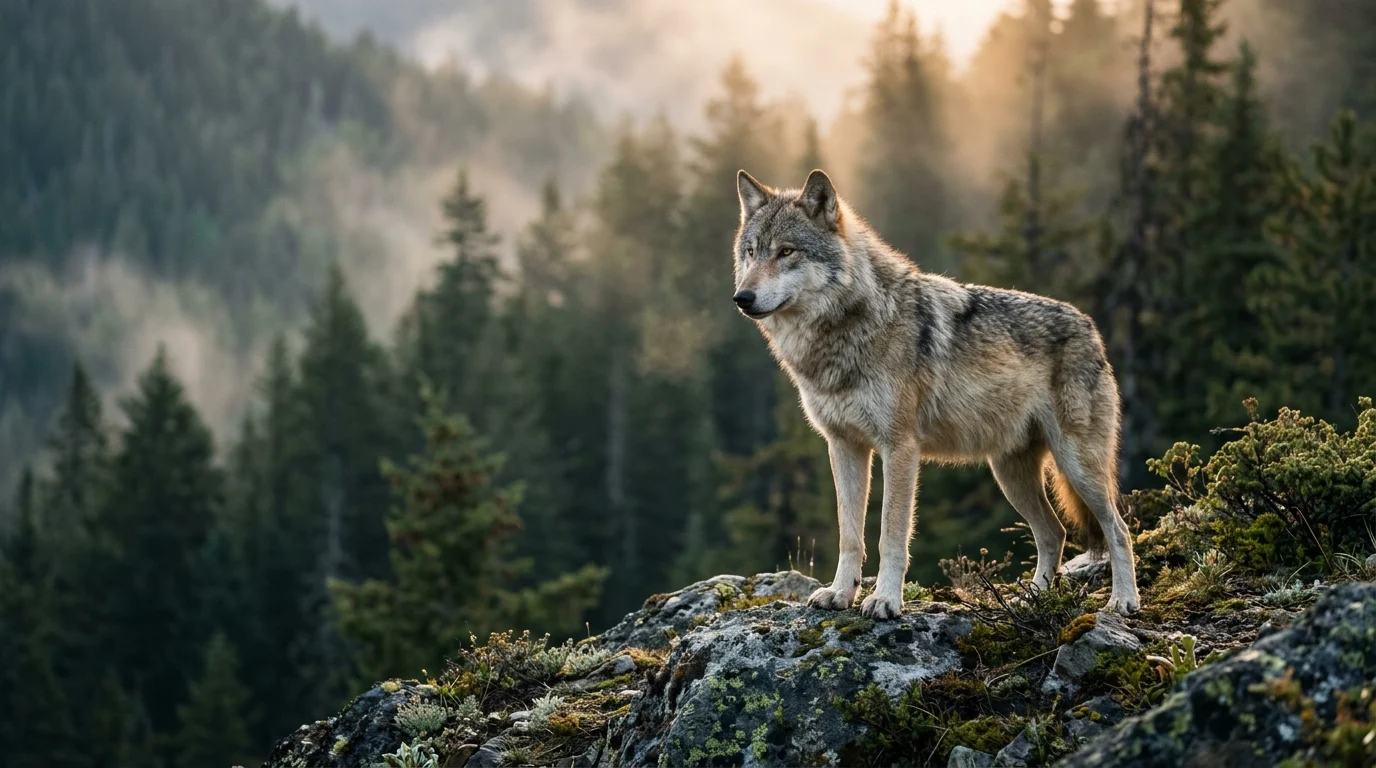
Wolf symbolism represents strength, loyalty, freedom, instinct, and the balance between independence and community. Across different cultures, the wolf has symbolized both a powerful protector and a mysterious wild creature. Its intelligence, resilience, and close family bonds make it a meaningful symbol of courage and connection.
People explore wolf symbolism to understand its spiritual significance, cultural history, dream interpretations, and lessons for everyday life. Whether you feel drawn to the wolf’s independence or admire its loyalty to the pack, this animal offers a powerful reminder to trust your instincts while respecting the people who matter most.
Wolf Symbolism Meaning (Clear Definition)
Wolf symbolism refers to the meanings and ideas people associate with wolves, including courage, loyalty, intuition, survival, leadership, and freedom. These meanings vary across cultures, spiritual traditions, literature, and personal experiences.
Wolves are social animals that often live and cooperate in family groups. Their behavior has inspired people to associate them with teamwork, communication, protection, and strong relationships.
At the same time, wolves are skilled hunters that depend on awareness and adaptability. This has made them symbols of determination, strategic thinking, and the ability to survive difficult circumstances.
In simple terms, wolf symbolism represents the strength to stand independently and the wisdom to recognize when cooperation matters.
What Does Wolf Symbolism Represent?
Wolf symbolism carries several important meanings. The interpretation often depends on the situation, cultural background, or personal connection someone has with this animal.

1. Strength and Courage
Wolves survive in challenging environments through physical ability, awareness, and adaptability. Symbolically, they represent the courage to face uncertainty and continue moving forward.

2. Loyalty and Family
Wolves cooperate within family groups, care for their young, and communicate with one another. Their social behavior makes them powerful symbols of loyalty, belonging, and mutual support.

3. Independence and Freedom
A wolf moving alone can represent self-reliance, personal freedom, and the willingness to follow an individual path. This interpretation does not mean that wolves naturally prefer isolation; it reflects the symbolic meaning people give to solitude.

4. Instinct and Intuition
A wolf’s alert senses and careful awareness inspire associations with instinct and observation. In personal symbolism, the wolf can encourage you to pay attention to your surroundings and consider your inner feelings before making decisions.

5. Communication and Leadership
Wolves use vocalizations, scent, posture, and other signals to coordinate and maintain social relationships. Symbolically, they represent clear communication, responsibility, and leadership that supports the group.
Wolf Symbolism at a Glance
| Symbolic meaning | What it represents |
|---|---|
| Strength | Resilience during difficult times |
| Loyalty | Trust, family, and lasting bonds |
| Freedom | Independence and personal choice |
| Intuition | Awareness and instinctive judgment |
| Protection | Caring for loved ones |
| Leadership | Responsibility and guidance |
| Transformation | Personal growth and adaptation |
| Mystery | The unknown and the untamed side of nature |
These meanings are interpretations rather than universal rules. A wolf may symbolize protection to one person and fear or uncertainty to another.
Spiritual Meaning of Wolf Symbolism
The spiritual meaning of wolf symbolism often centers on intuition, inner strength, personal growth, and connection with nature. In modern spiritual communities, the wolf is sometimes viewed as a guide that encourages people to discover their own strength and live with greater awareness.
However, spiritual interpretations differ between individuals and traditions. There is no single spiritual meaning that applies to everyone.
Wolf as a Spirit Animal
In some modern spiritual practices, people use the term spirit animal to describe an animal they feel represents their character, values, or life journey. A wolf may symbolize courage, loyalty, instinct, or the ability to maintain independence while remaining connected to others.
The phrase also has specific cultural contexts, including Indigenous traditions in which animal relationships may carry distinct meanings. It is important not to treat all Indigenous beliefs as identical or reduce sacred traditions to general personality labels.
Wolf as a Symbol of Inner Strength
The wolf’s ability to adapt to changing conditions makes it a meaningful symbol of resilience. Its presence in personal reflection can represent the determination to continue through uncertainty rather than surrender to fear.
If the wolf resonates with you, consider how you respond to challenges. Do you trust your judgment? Can you protect your boundaries while remaining open to support?
These questions turn symbolism into practical self-reflection.
Wolf Symbolism and Personal Transformation
Wolves also represent the journey toward greater self-understanding. Their wild nature can symbolize the parts of ourselves that we may ignore when trying too hard to satisfy other people’s expectations.
In this interpretation, the wolf encourages you to recognize your needs, acknowledge difficult emotions, and choose a path that reflects your values.
Personal transformation does not require rejecting others. Instead, the wolf’s social behavior offers another lesson: independence and meaningful relationships can exist together.
What Does Seeing a Wolf Symbolize Spiritually?
Some people interpret seeing a wolf as a reminder to trust their instincts, protect their energy, or reconnect with their sense of purpose. Others simply experience the encounter as a powerful moment in nature.
There is no established evidence that seeing a wolf predicts a future event or delivers a supernatural message. You can still use the experience as an opportunity to reflect on what courage, loyalty, or freedom means in your life.
Biblical / Religious Meaning of Wolf Symbolism
In the Bible, wolves generally appear as symbols of danger, destructive behavior, or threats to a vulnerable community. Their meaning depends on the passage and its message.
Wolves as Symbols of False Teachers
In Matthew 7:15, Jesus warns about false prophets who come in sheep’s clothing but are inwardly ravenous wolves. The imagery contrasts an innocent appearance with harmful intentions.
Here, the wolf represents deception and the importance of discernment. The passage encourages readers to evaluate people by their actions rather than trusting appearances alone.
Wolves as Symbols of Danger
In John 10:12, a wolf threatens the sheep, while the hired hand abandons them. This comparison highlights the difference between genuine care and self-interest.
Within this context, the wolf symbolizes a threat to the vulnerable and reinforces the value of protection, responsibility, and faithful leadership.
Wolves and Peace in Isaiah
Isaiah 11:6 describes a future vision in which the wolf dwells with the lamb. The image of traditionally opposing creatures living together conveys peace, harmony, and the transformation of conflict.
Unlike the warnings found in other passages, this image uses the wolf as part of a hopeful vision of reconciliation.
The biblical meaning of a wolf is therefore not entirely negative or positive. Its symbolism changes with the passage, ranging from danger and deception to a powerful image of peace and restored harmony.
Wolf Symbolism in History and Culture
Wolves have played important roles in myths, legends, folklore, and religious traditions. Because humans have lived alongside wolves for thousands of years, the animal has inspired both admiration and fear.
Wolves in Roman Mythology

One of the best-known wolf stories comes from Roman mythology. According to the legend, a she-wolf cared for the abandoned twins Romulus and Remus, who later became associated with the founding of Rome.
In this story, the wolf represents nourishment, protection, and the unexpected source of survival. The legend also demonstrates how an animal sometimes feared in nature can become a positive cultural symbol.
Wolves in Norse Mythology

In Norse mythology, wolves appear in powerful stories involving gods and the end of the world. Fenrir, a monstrous wolf, becomes a central figure in the events associated with Ragnarök.
Fenrir represents immense power, danger, and forces that are difficult to control. Other wolves in Norse stories are connected with cosmic imagery and the passage of time.
These myths show how wolves can symbolize both the strength of nature and the uncertainty surrounding powerful forces.
Wolves in Native American Traditions
Wolf symbolism varies widely among Indigenous nations and communities across North America. In some traditions and stories, wolves are associated with family, cooperation, hunting knowledge, courage, or teachings about relationships with the natural world.
There is no single Native American interpretation of the wolf. Each nation’s cultural practices, oral histories, and spiritual teachings have their own context, so individual traditions should be understood on their own terms.
Wolves in European Folklore
European folklore often presents wolves as dangerous creatures living beyond the safety of villages. Stories such as Little Red Riding Hood use the wolf to represent deception, vulnerability, and the risks of entering unfamiliar environments.
Other tales portray wolves as intelligent, mysterious, or even helpful. These contrasting depictions reflect changing human relationships with wilderness and the animals that inhabit it.
Wolves in Modern Popular Culture
Today, wolves appear in films, television, fantasy novels, games, clothing, and tattoos. They often represent independence, rebellion, strength, and loyalty.
The image of a lone wolf has become particularly popular as a symbol of self-reliance. Yet real wolves are highly social animals, making the lone-wolf image more of a cultural metaphor than a complete picture of wolf behavior.
Wolf Symbolism in Literature and Art
Writers and artists use wolves to explore human emotions, moral choices, social relationships, and the tension between civilization and wilderness.
The Wolf as a Villain
In traditional fairy tales, wolves frequently threaten innocent characters. Their sharp teeth, hunting behavior, and presence in forests make them effective symbols of danger.
In these stories, the wolf may represent manipulation, greed, hidden intentions, or fear of the unfamiliar. The character’s actions often matter more than the animal itself.
The Wolf as a Protector
Some stories reverse this familiar image by portraying wolves as guardians or companions. These characters may protect vulnerable individuals, form deep bonds, or guide heroes through difficult situations.
This interpretation connects the wolf with loyalty and courage, showing that strength can serve others rather than dominate them.
The Wolf as a Symbol of Freedom
In poetry, paintings, and modern fiction, a wolf roaming through mountains or forests can symbolize freedom from social expectations. Its distance from human settlements creates an image of independence and untamed possibility.
Artists often use this imagery to explore loneliness, self-discovery, and the desire to live authentically.
Wolves in Visual Art
Artists commonly emphasize a wolf’s eyes, posture, fur, and surroundings to communicate a particular mood. A wolf standing in sunlight may suggest confidence and alertness, while one pictured beneath a moonlit sky may evoke mystery and solitude.
The meaning depends on the artistic choices and the viewer’s interpretation. There is no fixed symbolic code for every wolf image.
Dream Meaning of Wolf Symbolism
Dreaming about a wolf can feel intense because wolves are associated with powerful emotions, social bonds, and wilderness. In dream interpretation, the animal may reflect personal concerns, relationships, fears, or feelings of independence.
Dream meanings are subjective. A dream does not reliably predict the future, and its significance depends on the dreamer’s experiences and emotions.
Dreaming of a Friendly Wolf
A friendly wolf may symbolize trust, loyalty, or a desire for companionship. It might also reflect confidence in your ability to handle a challenging situation.
Think about whether the wolf made you feel safe, curious, or understood. Those feelings may offer more useful clues than a universal dream dictionary.
Dreaming of a Wolf Chasing You
A wolf chasing you may reflect stress, conflict, or something you are reluctant to confront. The dream could prompt you to consider whether a situation in your waking life feels overwhelming.
It does not mean that danger is necessarily approaching. Instead, examine any unresolved worries that might be influencing your emotions.
Dreaming of a White Wolf
In some modern symbolic interpretations, a white wolf represents clarity, hope, purity, or guidance. For others, its unusual appearance may suggest mystery or a desire to understand something unfamiliar.
Your cultural background and personal associations can change the interpretation.
Dreaming of a Black Wolf
A black wolf may symbolize uncertainty, hidden fears, personal strength, or aspects of yourself that you do not fully understand. Its meaning depends heavily on whether the dream felt frightening, peaceful, or empowering.
Black does not automatically indicate evil, just as white does not always indicate goodness.
Dreaming of a Wolf Pack
A wolf pack in a dream may bring attention to family, teamwork, social pressure, or belonging. If the pack feels supportive, it may reflect a desire for stronger relationships; if it feels threatening, it could reflect tension within a group.
Consider how your current relationships affect your sense of security and independence.
Modern Meaning of Wolf Symbolism
In contemporary life, wolf symbolism appears in personal expression, fashion, tattoos, branding, and popular spirituality. People often choose wolf imagery because it communicates strength and individuality without requiring words.
Wolf Symbolism in Tattoos
Wolf tattoos can carry deeply personal meanings. Common interpretations include:
- Wolf head: Courage, awareness, and determination.
- Howling wolf: Communication, self-expression, and connection.
- Lone wolf: Independence and self-reliance.
- Wolf pack: Family, friendship, and loyalty.
- Geometric wolf: Balance between instinct, reason, and personal identity.
- Wolf and moon: Mystery, nature, and personal transformation.
These meanings are not universal. Someone may choose a wolf tattoo simply because they admire the animal or connect with a particular memory.
The Lone Wolf Meaning
The lone wolf is one of the most recognizable modern symbols of independence. It often describes someone who prefers making their own decisions, working independently, or following an unconventional path.
However, independence does not mean that a person must avoid relationships. A healthier interpretation recognizes that self-reliance and asking for help can coexist.
Wolf Symbolism in Leadership
Wolves can also represent leadership through cooperation and responsibility. In real wolf families, social relationships are more complex than the popular idea of a constantly fighting hierarchy.
As a metaphor, the wolf encourages leaders to communicate clearly, protect the group, and make decisions that consider the well-being of others.
What the Wolf Can Teach Us in Everyday Life
Wolf symbolism becomes most useful when its themes lead to practical choices.
- Trust your judgment, but remain willing to learn.
- Protect your boundaries without shutting everyone out.
- Value relationships that offer mutual respect.
- Adapt when circumstances change.
- Lead through responsibility rather than intimidation.
- Recognize when solitude helps and when connection matters more.
These lessons reflect the qualities people admire in wolves while recognizing that symbolism is a matter of interpretation.
Frequently Asked Questions About Wolf Symbolism
1. What does a wolf symbolize spiritually?
A wolf commonly symbolizes intuition, courage, loyalty, freedom, and inner strength in modern spiritual interpretations. Its meaning varies according to personal beliefs and cultural traditions.
2. Is wolf symbolism positive or negative?
Wolf symbolism can be positive or negative. It may represent loyalty, protection, and resilience, or danger, deception, and fear, depending on the cultural or literary context.
3. What does a lone wolf symbolize?
A lone wolf often represents independence, self-reliance, and the freedom to follow your own path. This is a cultural metaphor rather than a complete description of wolves, which are social animals.
4. What does it mean to dream about a wolf?
Dreaming about a wolf may reflect feelings about trust, fear, independence, or relationships. The emotional tone of the dream and your personal experiences are more useful than treating any interpretation as a guaranteed prediction.
5. What does a wolf symbolize in the Bible?
The Bible often uses wolves to represent danger or false teachers, as in Matthew 7:15. Isaiah 11:6 also uses the image of a wolf living with a lamb to express peace and harmony.
Conclusion
Wolf symbolism reminds us that strength involves more than power. It can mean trusting your instincts, adapting to change, protecting those you love, and knowing when to stand alone or work with others. Whether the wolf appears in a dream, a story, a spiritual reflection, or a tattoo, its meaning ultimately depends on the context and the values you connect with it.
SEO Title: Wolf Symbolism: Meaning, Spiritual Signs & Dreams
URL Slug: wolf-symbolism

I am Jasmine Marie, an administrator at SymbolBuz. I love exploring symbols and sharing their meanings to help readers understand their deeper stories, messages, and significance.