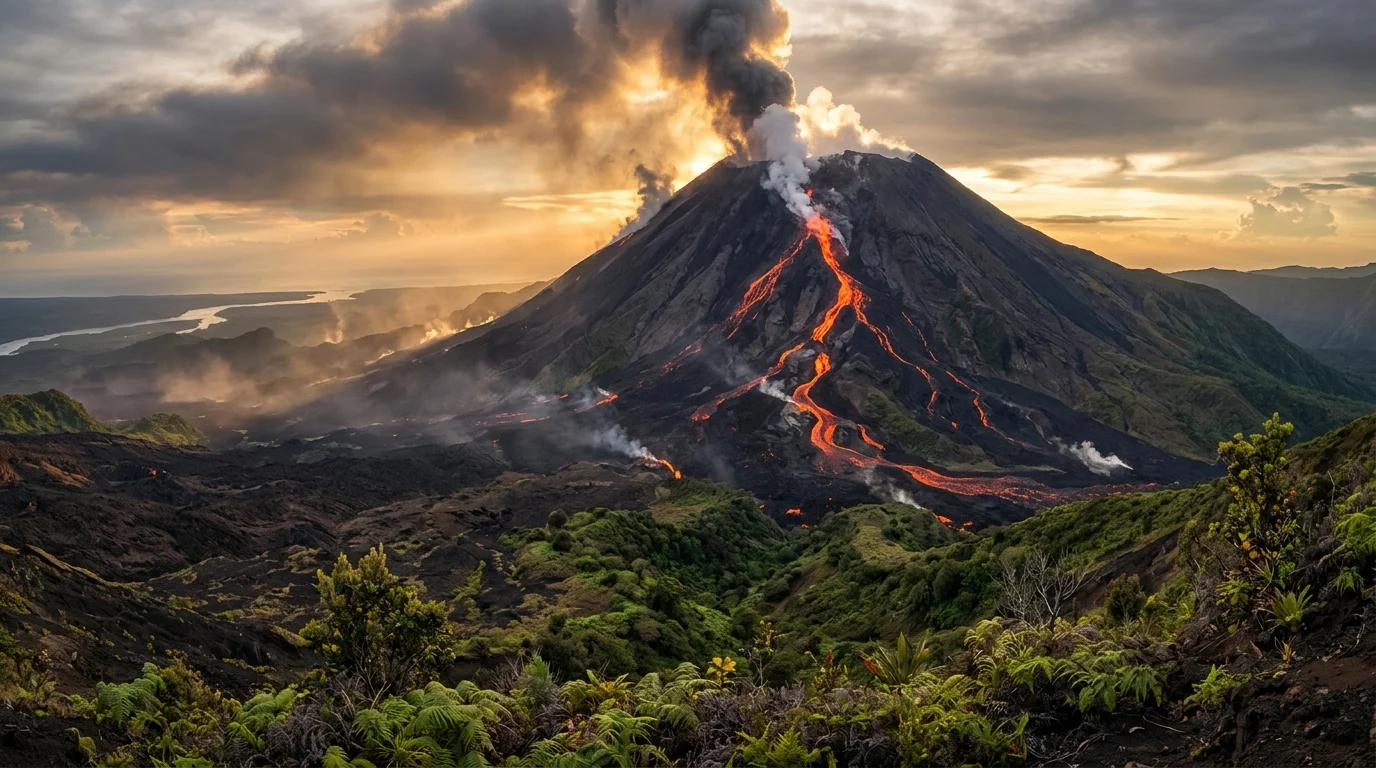
Volcano symbolism explores the powerful connection between nature, human emotions, spiritual transformation, and the forces that shape our lives. A volcano may appear peaceful for years before suddenly erupting, making it a compelling symbol of hidden feelings, sudden change, destruction, and renewal.
Across cultures, volcanoes have inspired both fear and admiration. Their immense power reminds us that even beneath a calm surface, tremendous energy can exist. A volcanic eruption can destroy familiar surroundings, yet volcanic soil can eventually support new growth.
Understanding volcano symbolism can help you explore its deeper meanings in spirituality, mythology, dreams, literature, and everyday life. Whether you encounter a volcano in a dream, a story, or a personal experience, its symbolism often points toward powerful emotions and the possibility of transformation.
Volcano Symbolism Meaning (Clear Definition)
Volcano symbolism represents powerful emotions, transformation, destruction, renewal, and the release of suppressed energy. It reflects the forces that build beneath the surface until they demand expression or create significant change.
A volcano can symbolize both danger and opportunity. An eruption may represent anger, emotional pressure, or an unexpected life event, while the fertile land that develops around volcanic regions symbolizes growth after hardship.
The meaning depends on the context in which the volcano appears. A dormant volcano may suggest hidden potential or unexpressed feelings, while an erupting volcano can represent a turning point that can no longer be ignored.
Here are the most common symbolic meanings of volcanoes:
- Transformation: A major change that reshapes your life.
- Suppressed emotions: Feelings that have accumulated and need healthy expression.
- Destruction and renewal: The end of one chapter and the beginning of another.
- Inner power: Strength, passion, and energy waiting to be expressed.
- Warning and danger: Tension, conflict, or a situation that requires attention.
- Spiritual awakening: A profound shift in awareness or personal beliefs.
- Unpredictability: Events that challenge your sense of stability and control.
At its heart, volcano symbolism teaches that powerful forces can be both destructive and creative. What matters is how those forces are understood, expressed, and directed.
What Does Volcano Symbolism Represent?
Volcanoes can represent several aspects of human experience. Their symbolism becomes especially meaningful when we consider how pressure builds, how eruptions occur, and how life eventually returns to affected landscapes.
1. Repressed Emotions and Inner Pressure
One of the strongest meanings associated with a volcano is emotional pressure.
Just as molten rock accumulates beneath Earth’s surface, frustration, sadness, fear, or resentment can build within a person when feelings remain unexpressed.
An erupting volcano may symbolize the moment when those emotions finally come out. This interpretation can encourage honest communication and healthier ways of handling stress before it becomes overwhelming.
The message is not that emotional expression is dangerous. Rather, it is that recognizing your feelings early can help you respond thoughtfully instead of reaching a breaking point.
2. Transformation and Personal Growth
Volcanoes dramatically change the landscapes around them. Lava can cover existing ground, create new land, and eventually contribute to fertile environments.
For this reason, volcano symbolism is closely associated with personal transformation.
A difficult breakup, career change, loss, or unexpected challenge can feel as though your familiar world has been destroyed. Yet these experiences may also create space for new priorities, stronger boundaries, and a clearer understanding of yourself.
Transformation does not mean every painful experience is beneficial. It means that change can sometimes become the starting point for meaningful growth.
3. Destruction and Renewal
A volcanic eruption can be devastating, especially for communities living nearby. Symbolically, this destructive power represents endings, disruption, and the loss of what once felt secure.
However, volcanic landscapes also demonstrate nature’s capacity for renewal. Over time, new ecosystems can develop on volcanic material, although recovery may take years or longer depending on the environment.
This dual meaning makes volcanoes powerful symbols of resilience. They remind us that endings can open possibilities, even when rebuilding takes patience.
4. Passion, Creativity, and Ambition
A volcano’s intense heat and explosive energy can symbolize passion, determination, and creative force.
In everyday life, this interpretation may relate to a person with strong ambitions, an artist developing a meaningful project, or someone discovering a long-neglected talent.
A volcano can therefore represent energy that needs direction rather than suppression. When passion is guided by patience and purpose, it can become a source of achievement rather than conflict.
5. Hidden Potential and Uncertainty
A dormant volcano may look peaceful even though geological activity can continue beneath it. This makes it a useful symbol of hidden potential and uncertainty.
It may represent an untapped ability, an unresolved issue, or a change that has not yet become visible.
Importantly, dormancy does not guarantee an eruption. Symbolically, this distinction matters: not every quiet situation is dangerous, and not every hidden emotion will lead to an outburst.
The volcano invites awareness without encouraging unnecessary fear.
Quick Guide to Volcano Symbolism
| Volcano image or feature | Common symbolic meaning |
| Erupting volcano | Emotional release, upheaval, intense change |
| Dormant volcano | Hidden potential, patience, unresolved tension |
| Extinct volcano | Closure, completed transformation, past struggles |
| Flowing lava | Unstoppable change, passion, powerful emotions |
| Volcanic ash | Loss, consequences, reflection, rebuilding |
| New land formed by lava | Renewal, fresh beginnings, resilience |
| Volcanic mountain | Strength, endurance, powerful inner resources |
These interpretations are symbolic rather than universal. Personal experiences and cultural traditions can give the same volcanic image very different meanings.
Spiritual Meaning of Volcano Symbolism
The spiritual meaning of volcano symbolism often centers on awakening, releasing old patterns, confronting inner truth, and embracing change.
In spiritual reflection, a volcano can represent the moment when something buried within you becomes impossible to ignore. This might be a long-standing desire, a conflict between your values and actions, or a growing awareness that your life needs to change.
Spiritual Awakening and Inner Energy
A volcanic eruption can symbolize a sudden shift in consciousness or a powerful realization.
You might recognize that a relationship no longer supports your well-being, discover a new sense of purpose, or begin questioning beliefs you have held for years.
Such experiences can feel intense because they challenge familiar ways of thinking. The volcano serves as a metaphor for the energy of change that emerges when an old perspective can no longer contain your developing understanding.
This is a spiritual interpretation, not evidence that a particular supernatural event is occurring.
Releasing Negative Energy
Volcano symbolism is sometimes associated with releasing negative energy, especially anger, resentment, fear, and emotional exhaustion.
The image encourages you to acknowledge what you have been carrying instead of pretending everything is fine.
Healthy release may involve journaling, prayer, meditation, exercise, creative work, or an honest conversation with someone you trust. These practices can help you process emotions without causing harm to yourself or others.
The deeper spiritual lesson is that peace does not require denying difficult feelings. It requires learning how to meet them with awareness.
Destruction as a Path to Renewal
In spiritual reflection, destruction can represent the ending of an outdated identity or belief system.
The eruption becomes a metaphor for the disruption that sometimes accompanies meaningful growth. Although familiar structures may disappear, new possibilities can gradually emerge.
This does not mean suffering is necessary for spiritual development. Instead, it suggests that difficult transitions can become opportunities to reconsider what matters most.
A Symbol of Sacred Power
Mountains and volcanoes have inspired reverence in many societies because of their size, mystery, and connection to dramatic natural forces.
A volcano may therefore symbolize a power greater than the individual, reminding people of nature’s scale and humanity’s limitations.
For some, this encourages humility. For others, it inspires awe, gratitude, and a stronger sense of connection with the natural world.
Biblical / Religious Meaning of Volcano Symbolism
The Bible does not establish a single, universal meaning for volcanoes. However, volcanic imagery can be considered alongside biblical descriptions of fire, mountains, earthquakes, smoke, and divine power.
These connections require care because the presence of fire or a mountain in a biblical passage does not necessarily indicate a literal volcano.
Fire as Judgment, Purification, and Divine Presence
In biblical literature, fire can represent several ideas, including God’s presence, judgment, purification, and power.
For example, Exodus 19 describes smoke and fire on Mount Sinai during the encounter between God and the Israelites. The scene emphasizes the mountain’s holiness and the overwhelming character of the divine presence.
A modern reader might associate this dramatic imagery with a volcanic landscape, but the passage does not explicitly identify Mount Sinai as an erupting volcano.
Symbolically, the comparison can suggest awe, accountability, transformation, and the recognition of powers beyond human control.
Mountains as Places of Encounter
Mountains occupy an important place in many religious traditions, including Christianity, Judaism, Hinduism, and Buddhism.
In biblical narratives, mountains can be settings for revelation, prayer, covenant, and spiritual encounters. A volcano, as a powerful type of mountain, may evoke similar feelings of reverence when interpreted through a religious lens.
However, volcano symbolism should not be treated as a fixed biblical doctrine.
Volcanoes and the End Times
Some people connect volcanic eruptions with biblical prophecies involving earthquakes, fire, smoke, or dramatic changes in the natural world.
Such interpretations are matters of religious belief rather than established conclusions. Biblical descriptions of natural upheaval do not automatically predict a specific volcanic eruption or prove that an event signals the end of the world.
A balanced religious interpretation emphasizes humility, reflection, and responsible action instead of fear-based predictions.
Religious Interpretations Beyond Christianity
In other traditions, volcanoes can be connected to sacred landscapes, deities, creation stories, and the relationship between humanity and nature.
For example, the Hawaiian volcano deity Pele is associated with volcanic activity, fire, and the shaping of the islands. This tradition has its own cultural and spiritual significance and should not be reduced to a generic symbol of anger or destruction.
Across religious traditions, volcanoes can evoke reverence, creative power, danger, and respect for forces beyond ordinary human control.
Volcano Symbolism in History and Culture
Throughout history, volcanic landscapes have influenced mythology, religious practices, folklore, and local identities.
For communities living near active volcanoes, eruptions are not merely abstract symbols. They are real events that can shape settlement patterns, agriculture, livelihoods, and cultural memory.
Ancient Greece and Rome
Ancient Greek and Roman traditions associated volcanic activity with powerful supernatural forces.
In Greek mythology, Hephaestus was the god of fire and metalworking, while Roman tradition identified the corresponding deity as Vulcan. Their associations with fire and the forging of metal helped shape later cultural connections between volcanic heat and creative power.
The Roman name Vulcan also contributed to the modern English word volcano.
These traditions reflect attempts to understand dramatic natural phenomena through the religious and mythological frameworks of their time.
Hawaiian Culture and Pele
In Hawaiian tradition, Pele is a major deity associated with volcanoes and volcanic activity. Stories about Pele are part of a living cultural tradition connected to the Hawaiian Islands.
The symbolism of volcanic land in this context includes creation, power, danger, and the shaping of place. It also reflects a relationship between people, ancestral stories, and the natural environment.
Pele’s significance cannot be fully understood by treating her simply as a metaphor for anger. Hawaiian cultural perspectives are diverse and deserve to be approached respectfully.
Indonesian and Japanese Traditions
In Indonesia, volcanoes have influenced local spiritual traditions, historical events, and community relationships with the landscape. Mount Merapi, for example, has deep cultural significance in the Yogyakarta region.
In Japan, Mount Fuji holds major spiritual, cultural, and artistic importance. Although it is a volcano, it is also widely recognized as a sacred mountain and a national symbol.
These examples show that volcanoes can represent far more than destruction. They may also symbolize identity, sacredness, continuity, and the enduring relationship between people and their environment.
Volcanoes as Symbols of Human Vulnerability
Historic eruptions, including the destruction of Pompeii and Herculaneum following the eruption of Mount Vesuvius in AD 79, have shaped how people imagine volcanic power.
These events reveal the vulnerability of human settlements to natural forces. They also demonstrate why volcanic symbolism often includes humility, impermanence, and the limits of human control.
At the same time, volcanic regions continue to support communities through fertile soils, geothermal energy, tourism, and distinctive landscapes.
The cultural meaning of a volcano is therefore shaped by both its risks and its benefits.
Volcano Symbolism in Literature and Art
In literature and visual art, volcanoes provide vivid imagery for emotions and events that are difficult to express directly.
Their dramatic appearance makes them useful symbols for inner conflict, social unrest, overwhelming desire, and sudden transformation.
Volcanoes as Metaphors for Human Emotions
Writers often use volcanic imagery to describe anger that has been building for a long time.
A character may appear calm while secretly struggling with resentment, grief, or ambition. The eventual eruption represents the moment when those feelings become visible.
This metaphor is effective because it connects an internal psychological process with an easily understood natural event.
Volcanoes can also represent passion and creativity. A powerful artistic idea may resemble an eruption, emerging suddenly after a long period of quiet thought.
Volcanoes as Symbols of Conflict
In novels, poems, and political writing, an erupting volcano may symbolize a society approaching a breaking point.
Long-standing injustice, social pressure, or political dissatisfaction can build beneath an apparently stable system. An uprising or revolution may then be compared to an eruption.
The image suggests that dramatic change often has deeper causes that existed long before the visible event.
However, social conflicts are more complex than geological processes. The metaphor is useful for illustrating pressure and sudden release, not for proving that human events are inevitable.
Volcanoes in Painting and Visual Art
Artists have long been fascinated by the contrast between a volcano’s beauty and its destructive potential.
Dark smoke, glowing lava, towering mountains, and changing skies create striking visual compositions. These elements can evoke fear, wonder, vulnerability, or admiration.
Romantic and landscape artists often emphasized the power of nature in ways that challenged the idea that humans could fully control their surroundings.
Modern artists may use volcanoes to explore climate concerns, environmental vulnerability, political upheaval, or personal transformation.
In visual art, the volcano becomes more than a geographical feature. It is a dramatic reminder of the forces that exist beyond the human scale.
Dream Meaning of Volcano Symbolism
Dreams about volcanoes can feel intense because they involve powerful images of pressure, heat, destruction, and sudden change.
There is no scientifically established universal meaning for a volcano dream. Its interpretation depends on your personal experiences, emotions, and circumstances.
Still, exploring the imagery can help you reflect on concerns or feelings that may be important in your waking life.
Dreaming of an Erupting Volcano
An erupting volcano may symbolize overwhelming emotions, a stressful situation, or a major change that feels difficult to control.
Consider whether you have been experiencing conflict, carrying too many responsibilities, or avoiding a difficult conversation.
The dream does not predict that something bad will happen. Instead, it may provide an opportunity to reflect on what currently feels intense or unresolved.
Dreaming of a Dormant Volcano
A dormant volcano may represent quiet potential, hidden concerns, or a situation that appears stable.
Ask yourself whether you are waiting to pursue a goal, holding back an important opinion, or sensing tension in a relationship.
The dream’s emotional tone matters. Feeling peaceful near a dormant volcano may suggest comfort with uncertainty, while feeling afraid could reflect worry about what might happen next.
Dreaming of Escaping a Volcanic Eruption
Trying to escape an eruption may reflect a desire to avoid pressure, conflict, or a difficult transition.
It may also represent your instinct to protect yourself from an overwhelming situation.
Rather than assuming the dream predicts danger, consider whether there is something in your daily life that needs boundaries, planning, or direct attention.
Dreaming of Lava Flowing Toward You
Flowing lava may symbolize a problem that seems to be getting closer or a situation that feels increasingly difficult to avoid.
It could also represent powerful motivation or a change that is moving forward faster than expected.
Think about whether you feel threatened, excited, helpless, or determined in the dream. Your emotional response can provide more useful personal context than a generic dream dictionary definition.
Dreaming of Surviving a Volcanic Eruption
Surviving an eruption may symbolize resilience, adaptation, or confidence in your ability to navigate difficulties.
If the dream ends with safety or a renewed landscape, you might reflect on how you have recovered from past challenges.
However, dreams are not reliable predictions of future events. Their value often lies in the questions they encourage you to ask about your feelings and experiences.
Modern Meaning of Volcano Symbolism
In modern life, volcano symbolism remains relevant because people regularly experience pressure, rapid change, uncertainty, and the need to adapt.
The metaphor can help explain personal struggles, creative ambition, environmental awareness, and social transformation.
Emotional Health and Self-Awareness
Modern interpretations often use volcanoes to describe the consequences of ignoring emotions for too long.
Repeated stress, unresolved disagreements, and unspoken needs can contribute to emotional exhaustion. The volcano metaphor encourages people to notice these pressures before they become overwhelming.
Practical responses include setting boundaries, seeking support, taking breaks, and communicating clearly.
It is important to remember that emotions do not always build toward an outburst. With awareness and appropriate support, people can process difficult feelings in many different ways.
Career Changes and Personal Reinvention
A volcano can symbolize the point at which a familiar way of living no longer feels sustainable.
You might be considering a new career, leaving an unfulfilling routine, developing a creative project, or changing your priorities.
These transitions can be uncomfortable because they challenge established patterns. Volcano symbolism offers a reminder that change can create new possibilities, even when the transition itself is uncertain.
You do not need to wait for a crisis to begin again. Small, deliberate decisions can create meaningful change without an emotional eruption.
Creativity and Innovation
Creative breakthroughs sometimes follow long periods of preparation, experimentation, and uncertainty.
The volcano serves as a metaphor for ideas that eventually find a powerful form of expression. This can apply to writing, art, scientific discovery, entrepreneurship, or personal projects.
The practical lesson is to give your ideas both space and structure. Inspiration provides energy, but consistent effort helps turn that energy into something valuable.
Environmental Awareness and Natural Power
In environmental discussions, volcanoes can symbolize humanity’s relationship with the natural world.
Volcanic eruptions remind us that Earth is an active planet whose processes can profoundly affect communities. Volcanic ash and gases can influence air quality and climate, while volcanic landscapes can also support biodiversity and provide geothermal resources.
Scientific understanding is essential here. Volcanic eruptions are geological events caused by processes involving magma, gases, and Earth’s crust, not moral messages or reliable predictions of personal destiny.
Recognizing both the hazards and benefits of volcanic activity encourages informed preparation and respect for the environment.
Social Change and Collective Emotions
Volcano symbolism is also used to describe social pressure and collective frustration.
When communities experience prolonged injustice, economic hardship, or political tension, a sudden protest or major social shift may be described as an eruption.
This imagery highlights how visible change can emerge from long-standing conditions. It also reminds observers to examine underlying causes rather than focusing only on dramatic events.
In this context, the volcano represents both the intensity of collective emotions and the possibility of reshaping existing structures.
How to Apply Volcano Symbolism to Your Own Life
You can use volcano symbolism as a practical reflection tool rather than treating it as a prediction or fixed spiritual message.
Consider these questions:
- What am I feeling? Identify emotions you may have been ignoring or struggling to express.
- Where am I experiencing pressure? Look at work, relationships, responsibilities, and personal expectations.
- What needs to change? Distinguish between temporary frustration and deeper concerns that require action.
- How can I release tension safely? Consider honest communication, rest, creative activities, or professional support when appropriate.
- What could I rebuild? Identify one realistic step toward a healthier routine, stronger relationship, or meaningful goal.
You do not have to interpret every volcanic image as a warning. Sometimes it can simply represent energy, courage, ambition, or the possibility of a fresh start.
The most useful interpretation is the one that helps you understand your circumstances more clearly and make thoughtful decisions.
FAQS:
What is the main meaning of volcano symbolism?
Volcano symbolism primarily represents powerful emotions, transformation, destruction, renewal, and hidden energy. Its meaning depends on the context, ranging from emotional pressure to personal growth and creative potential.
What does a volcano symbolize spiritually?
Spiritually, a volcano can symbolize awakening, the release of old patterns, inner strength, and profound change. These meanings are interpretive and vary across personal beliefs and cultural traditions.
Is a volcano a symbol of anger?
A volcano can symbolize anger, especially when emotions have been suppressed for a long time. However, it can also represent passion, creativity, ambition, renewal, and the energy needed to make a meaningful change.
What does a volcano mean in a dream?
A volcano dream may reflect stress, intense emotions, uncertainty, or a significant transition in your life. Dreams do not have universally proven meanings and should not be treated as predictions of future events.
What does an erupting volcano symbolize in different cultures?
An erupting volcano may represent divine power, destruction, creation, danger, or renewal, depending on the culture. Hawaiian traditions involving Pele, for example, connect volcanic activity with a culturally significant deity and the shaping of the islands.
Conclusion:
Volcano symbolism reminds us that powerful forces can exist beneath even the calmest surface. It represents the complexity of human emotions, the disruption that accompanies change, and the possibility of renewal after difficult experiences.
Whether a volcano appears in a dream, a spiritual reflection, a work of art, or a cultural story, its meaning depends on the context in which it is understood.
Its most valuable lesson is not that every pressure must end in an eruption. Rather, it is that awareness, thoughtful expression, and adaptability can help us navigate change and turn difficult moments into opportunities for growth.

I explore symbols, special characters, emojis, and their meanings, sharing simple, useful insights to help readers discover, understand, and creatively use symbols in everyday digital communication.