Frog symbolism is often associated with transformation, renewal, fertility, prosperity, and emotional growth. Across different cultures, frogs represent the ability to adapt to change, embrace new opportunities, and move forward with confidence. Their remarkable life cycle, from tadpole to adult frog, makes them powerful symbols of personal development and new beginnings.
Seeing a frog in nature, dreaming about one, or noticing frog imagery in art may inspire you to reflect on your own life. Some people interpret frogs as spiritual signs of abundance, cleansing, or positive change, while others connect them with nature, fertility, and good fortune.
Although meanings vary across cultures and personal beliefs, frog symbolism offers a valuable reminder that growth often begins with change.
Frog Symbolism Meaning (Clear Definition)
Frog symbolism refers to the meanings people associate with frogs, including transformation, renewal, fertility, adaptability, cleansing, and prosperity.
Because frogs undergo a dramatic physical transformation during their lives, many traditions use them to represent personal growth and the transition from one stage of life to another.
The frog’s connection to water also links it with emotions, intuition, and purification. Meanwhile, its ability to live both in water and on land makes it a symbol of adaptability and balance.
Common meanings of frog symbolism include:
- Transformation: Embracing change and becoming a new version of yourself.
- Renewal: Releasing old habits and welcoming fresh beginnings.
- Prosperity: Attracting abundance and recognizing opportunities.
- Fertility: Representing reproduction, growth, and new life.
- Cleansing: Letting go of emotional burdens and starting afresh.
- Adaptability: Adjusting to unfamiliar situations with patience.
- Emotional balance: Exploring feelings and developing greater self-awareness.
Ultimately, the frog reminds us that change can create opportunities for growth, even when the process feels unfamiliar.
What Does Frog Symbolism Represent?
Frogs can represent several ideas depending on their appearance, behavior, and cultural setting. Their symbolism often reflects the natural characteristics that make these amphibians unique.
1. Transformation and Personal Growth
A frog begins life as an egg, develops into a tadpole, and eventually becomes an adult. This life cycle makes it a natural symbol of transformation.
In everyday life, frog symbolism may encourage you to accept changes in your relationships, career, personal goals, or beliefs. It reminds you that progress happens gradually, even when you cannot immediately see the results.
2. Renewal and New Beginnings
Frogs often appear near ponds, streams, and wetlands, where seasonal changes shape their environment. Their association with water and life has helped connect them with renewal.
A frog may therefore symbolize a fresh start after a difficult period. You might interpret its appearance as a reminder to leave unhelpful habits behind and make room for healthier choices.
3. Prosperity and Good Fortune
In several cultural traditions, frogs symbolize wealth, abundance, and good luck. Their association with rain, fertile land, and thriving ecosystems helps explain these connections.
Some people also keep frog figures as symbols of financial success or business prosperity. These are cultural beliefs rather than guarantees that money or good fortune will follow.
4. Fertility and Abundance
Many frog species lay large numbers of eggs, making frogs symbols of reproduction, fertility, and the continuation of life.
Their presence in a healthy wetland can also reflect a thriving natural environment. As a symbol, the frog may represent a period when ideas, relationships, or creative projects have room to grow.
5. Adaptability and Resilience
Frogs have evolved to survive in different environments, although individual species have specific habitat requirements. Their flexibility makes them useful symbols of resilience.
Frog symbolism can encourage you to respond thoughtfully when circumstances change. Instead of resisting every challenge, you can learn new skills, adjust your expectations, and discover alternative ways forward.
Spiritual Meaning of Frog Symbolism
The spiritual meaning of frogs often centers on transformation, emotional cleansing, intuition, and renewal. In spiritual traditions and modern personal interpretations, frogs can serve as reminders to release what no longer supports your growth.
These meanings are subjective and depend on individual beliefs rather than established supernatural facts.
Frog as a Symbol of Spiritual Transformation
A frog’s life cycle represents the process of becoming. Spiritually, this transformation may reflect a shift in your priorities, a deeper understanding of yourself, or the beginning of a new chapter.
If a frog catches your attention during a period of uncertainty, you might use the experience as an opportunity to consider what needs to change in your life.
Frog Symbolism and Emotional Cleansing
Water plays an important role in many spiritual traditions, where it often represents purification, healing, and emotional renewal.
Because frogs depend on moist environments and are closely associated with water, some interpretations connect them with releasing emotional burdens. The symbolism may encourage you to process difficult feelings rather than ignore them.
Frog Symbolism and Intuition
Frogs are sensitive to changes in their surroundings, and many species rely on sound, movement, and environmental cues to survive.
Symbolically, this connection can represent awareness and attentiveness. A frog may inspire you to listen carefully to your feelings, observe your surroundings, and make decisions with greater intention.
Frog as a Sign of Positive Change
Some spiritual interpretations view a frog encounter as a reminder that new opportunities may be approaching.
Rather than treating the encounter as a prediction, consider it an invitation to recognize possibilities already present in your life. Sometimes, a meaningful change begins with a small decision.
Biblical / Religious Meaning of Frog Symbolism
Frogs appear in the Bible, particularly in the account of the plagues of Egypt in the Book of Exodus. Their religious meaning differs from the positive symbolism found in some other traditions.
Frogs in the Bible
In Exodus 8, frogs are one of the plagues that God brings upon Egypt through Moses and Aaron. The frogs spread throughout the land, entering homes and everyday spaces.
Within this biblical narrative, frogs represent a disruptive judgment and demonstrate the power of God in the story of the Israelites’ deliverance from Egypt.
This context is important because the biblical portrayal does not primarily present frogs as symbols of prosperity or spiritual renewal.
Frogs in the Book of Revelation
Revelation 16:13 describes three unclean spirits resembling frogs emerging from the mouths of the dragon, the beast, and the false prophet.
In this passage, frog-like imagery is associated with deception and unclean spiritual forces. Its meaning is specific to the apocalyptic vision and should not automatically be applied to every frog encountered in everyday life.
Frog Symbolism Across Religious Beliefs
Religious interpretations vary significantly. Some traditions associate frogs with fertility, rainfall, or renewal, while the biblical passages mentioned above use them in more troubling contexts.
Understanding the original religious setting helps avoid assuming that every culture gives the frog the same spiritual meaning.
Frog Symbolism in History and Culture
Frogs have appeared in folklore, religious traditions, mythology, and decorative art for centuries. Their meanings often reflect local environments, agricultural needs, and beliefs about life and death.
Ancient Egyptian Frog Symbolism

In ancient Egyptian religion, the frog was associated with fertility, birth, and regeneration. The goddess Heqet, often depicted with a frog’s head or in frog form, was connected with childbirth and the protection of mothers and infants.
The appearance of frogs in environments shaped by the Nile’s seasonal flooding helped reinforce their association with life and fertility.
For ancient Egyptians, frog imagery could therefore express hopes for healthy births, renewed life, and the continuation of the community.
Chinese Frog Symbolism

In Chinese cultural traditions, the three-legged money frog, often called Jin Chan, is associated with wealth and financial fortune.
This traditional figure frequently appears with coins or other symbols of prosperity. People who follow feng shui practices may display it as a symbolic reminder of abundance and financial aspirations.
Its meaning belongs to a particular cultural tradition; it does not mean that an actual frog or decorative figure guarantees wealth.
Frog Symbolism in Japanese Culture
Frogs are associated with different ideas in Japanese folklore and everyday culture. One popular association comes from the Japanese word kaeru, which can mean both “frog” and “to return.”
This wordplay has helped connect frogs with safe returns, especially for travelers. Frog motifs also appear on charms and personal objects intended to symbolize a safe journey or the return of something valuable.
Frog Symbolism in Folklore
European folklore includes stories in which frogs transform into princes or other unexpected figures. These tales often explore hidden potential, the difference between appearance and character, and the possibility of change.
Other folk traditions connect frogs with rainfall, fertility, and agricultural success because their activity often coincides with wet weather.
Across these examples, the frog’s meaning changes with the cultural story surrounding it.
Frog Symbolism in Literature and Art
Frogs offer writers and artists a flexible symbol because they can represent both ordinary natural life and extraordinary transformation.
Frogs as Symbols of Transformation in Fairy Tales
One of the best-known examples is the fairy tale commonly known as The Frog Prince. In versions of this story, a frog becomes a prince after a transformation connected with the plot’s central conflict.
The story has inspired interpretations about looking beyond appearances, keeping promises, and discovering unexpected qualities in others.
The frog’s transformation also suggests that a person’s current situation does not necessarily define their future.
Frogs in Poetry and Storytelling
Writers may use frogs to evoke wetlands, rain, nighttime sounds, or the quiet rhythms of nature. Their croaking can establish a peaceful atmosphere or create an unsettling mood, depending on the setting.
In symbolic writing, frogs can represent renewal, awkwardness, comic relief, or the surprising beauty of ordinary creatures.
Frogs in Visual Art
Artists often use frog imagery in paintings, ceramics, sculptures, and decorative objects. In some works, frogs symbolize prosperity or fertility; in others, they simply celebrate wildlife and the natural environment.
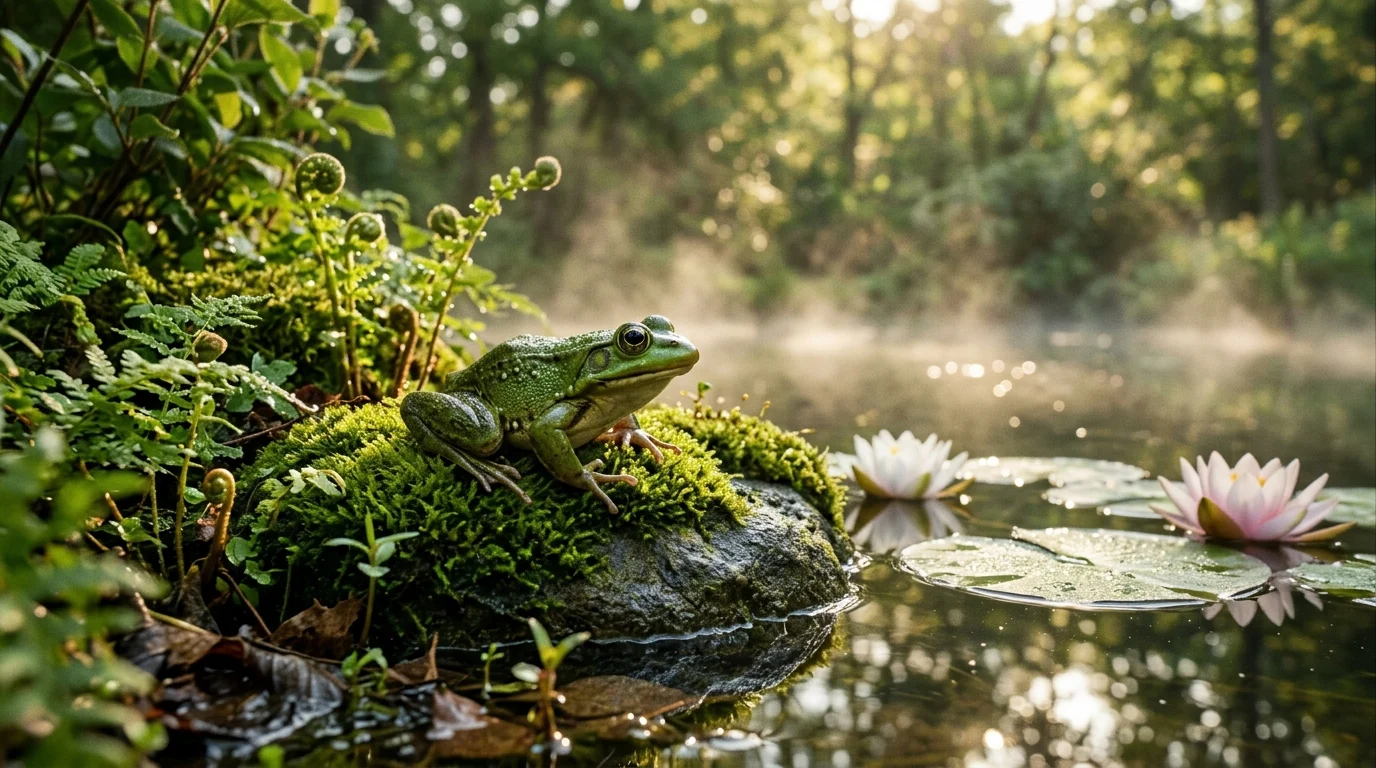
The surrounding imagery usually helps establish the intended meaning. A frog beside coins may suggest wealth, while one among water lilies may emphasize nature and renewal.
Dream Meaning of Frog Symbolism
Dreaming about a frog can have several possible interpretations, depending on the dream’s details and your personal associations with the animal.
Dreams do not have universally established meanings, and a frog dream should not be treated as a reliable prediction of future events.
Here are some common symbolic interpretations.
| Frog dream | Possible symbolic meaning |
|---|---|
| Seeing a frog | Awareness of change or a new opportunity |
| A green frog | Growth, nature, or renewal |
| A frog jumping | Movement, flexibility, or taking a chance |
| A frog in water | Emotional reflection or adjustment |
| A frog entering your home | Change affecting your personal life |
| A large frog | A major concern, opportunity, or transition |
| A frog chasing you | Avoidance of an uncomfortable issue |
| A frog changing into something else | Personal development or changing perceptions |
Dreaming of a Green Frog
A green frog may bring to mind growth, freshness, and the natural world. If the dream feels peaceful, you might associate it with hope or the possibility of a fresh start.
Your personal experiences and emotions are more important than any fixed interpretation.
Dreaming of a Frog Jumping
A jumping frog can symbolize movement, quick decisions, or the desire to escape a limiting situation.
Consider whether you are preparing to take a risk, make a change, or move toward a goal in waking life.
Dreaming of a Frog in Water
Water commonly symbolizes emotions in many approaches to dream interpretation. A frog swimming or resting in water may therefore invite reflection on your feelings and your ability to adapt.
The dream’s atmosphere matters: calm water may feel reassuring, while rough or murky water may reflect uncertainty.
Modern Meaning of Frog Symbolism
Today, frog symbolism appears in personal development, environmental awareness, popular culture, home decoration, and spiritual practices.
Modern interpretations often combine traditional beliefs with the frog’s biological characteristics.
Frog Symbolism in Personal Growth
The frog’s transformation from tadpole to adult provides a powerful metaphor for personal development.
You may connect this symbolism with learning a new skill, recovering confidence, changing careers, or developing healthier relationships. The message is simple: growth takes time, and each stage has value.
Frog Symbolism and Environmental Awareness
Frogs are important parts of many ecosystems, and numerous species are sensitive to changes in water quality, habitat, disease, and climate.
Scientists use amphibians, including frogs, in ecological research and conservation efforts. Their environmental importance gives them a modern symbolic connection with biodiversity and the protection of natural habitats.
In this context, the frog can remind us that human well-being is connected to the health of the natural world.
Frog Symbolism in Good Luck Charms
Frog figures appear in jewelry, ornaments, charms, and decorative objects associated with good fortune.
Some people use them as reminders of prosperity, resilience, or positive intentions. Others appreciate frogs simply because they represent wildlife or have personal significance.
Frog Symbolism in Everyday Life
A frog encounter does not have to carry a supernatural message to feel meaningful. It can simply remind you to pay attention to your surroundings and appreciate the natural world.
If you personally connect frogs with renewal or adaptability, that association can help you reflect on your goals and approach challenges with a fresh perspective.
Frequently Asked Questions About Frog Symbolism
1. What does a frog symbolize spiritually?
A frog commonly symbolizes transformation, renewal, emotional cleansing, and adaptability in modern spiritual interpretations. Some traditions also associate frogs with fertility, abundance, and prosperity.
2. Is seeing a frog a sign of good luck?
Some cultural traditions consider frogs symbols of good fortune, wealth, or positive change. However, seeing a frog does not guarantee that a particular event will happen.
3. What does a frog symbolize in the Bible?
In the Bible, frogs appear in the plagues of Egypt in Exodus and in the imagery of Revelation 16:13. These passages associate frogs with divine judgment and unclean spirits rather than the prosperity symbolism found in some other cultures.
4. What does it mean when you dream about a frog?
A frog dream may represent change, growth, adaptability, or emotional reflection, depending on the context. Your feelings during the dream and your current life circumstances can help you explore its personal significance.
5. What does a frog symbolize in different cultures?
Frogs can symbolize fertility and regeneration in ancient Egyptian traditions, wealth in some Chinese cultural practices, and safe returns in Japanese wordplay and folklore. Their meanings vary according to the cultural and historical context.
Conclusion
Frog symbolism reminds us that transformation, renewal, and adaptability are natural parts of life. From ancient Egyptian associations with fertility to modern ideas about personal growth and prosperity, frogs carry meanings shaped by culture, religion, and individual experience. Whether you see a frog as a symbol of good fortune or simply a remarkable creature, its life cycle offers an enduring lesson: change can open the door to growth and new possibilities.

I explore the meanings, history, and cultural significance behind symbols, helping readers understand how symbols connect with ideas, emotions, traditions, and everyday life.