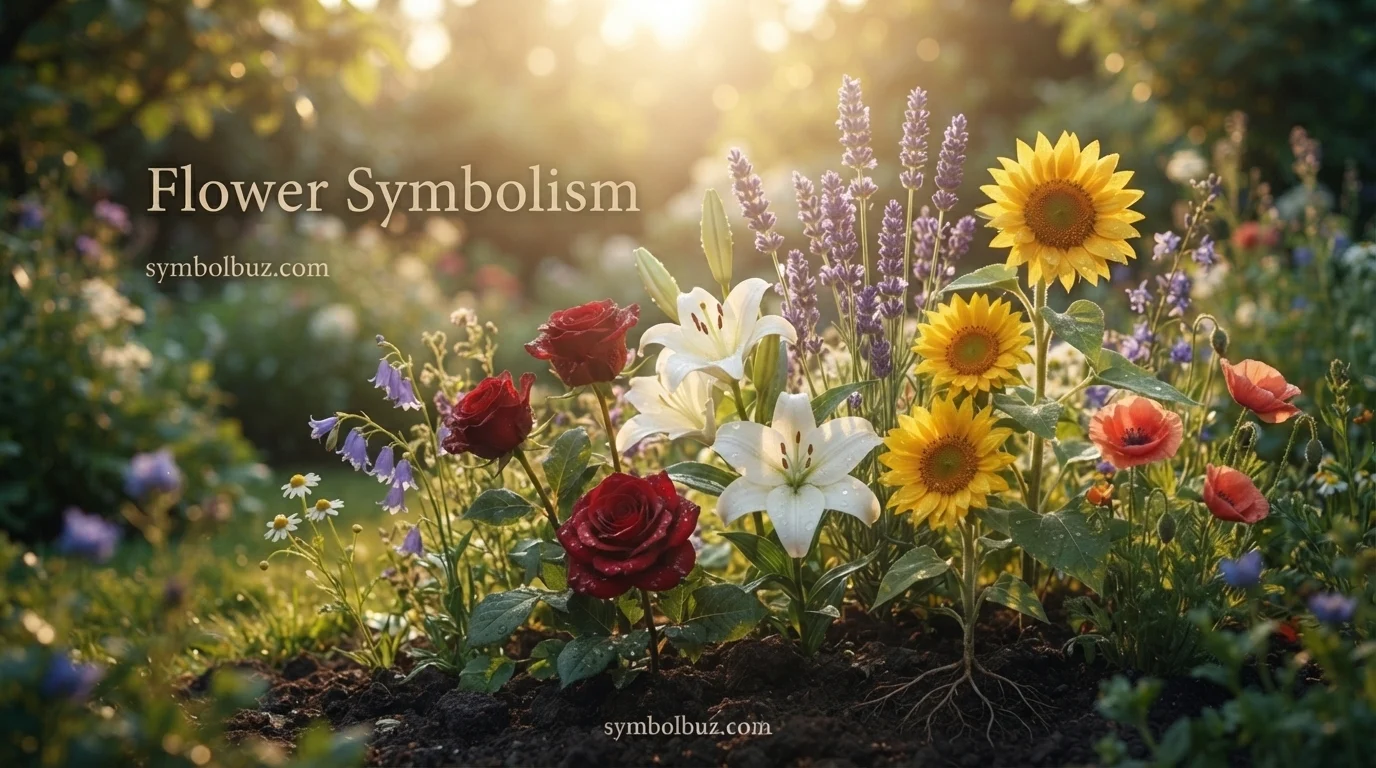
Flowers have fascinated people for centuries because they combine beauty, growth, fragility, and renewal in a single natural form. Flower symbolism explores the meanings people have traditionally associated with flowers, colors, seasons, and the way flowers are given or displayed.
From love and friendship to grief, hope, purity, and transformation, different flowers can communicate emotions that words sometimes cannot. Understanding these meanings can add depth to gifts, celebrations, artwork, dreams, gardens, and personal experiences.
Flower Symbolism Meaning (Clear Definition)
Flower symbolism is the practice of giving flowers symbolic meanings based on their appearance, color, cultural traditions, history, and emotional associations.
Flowers often represent universal human experiences such as:
- Love and romance
- Beauty and admiration
- Growth and transformation
- Purity and innocence
- Hope and renewal
- Grief and remembrance
- Friendship and affection
- Life, death, and the passage of time
The exact meaning depends on the flower and the cultural context. A rose, for example, can symbolize love, while a lily may represent purity, remembrance, or spiritual hope.
What Does Flower Symbolism Represent?
Flower symbolism represents the many stages and emotions of human life. Because flowers grow, bloom, wither, and return through seasonal cycles, they naturally became symbols of change and impermanence.
| Flower | Common Symbolic Meaning |
|---|---|
| Rose | Love, passion, beauty |
| Lily | Purity, renewal, remembrance |
| Sunflower | Happiness, loyalty, optimism |
| Lotus | Spiritual awakening, rebirth, enlightenment |
| Daisy | Innocence, simplicity, new beginnings |
| Tulip | Affection, perfect love, elegance |
| Lavender | Calmness, devotion, healing |
| Cherry Blossom | Transience, renewal, beauty |
Flowers and Love
Flowers are among the most recognizable symbols of romantic love. Red roses traditionally communicate passion, while softer flowers can express tenderness, admiration, or affection.
Flowers and Growth
A blooming flower can symbolize personal development. Its journey from seed to blossom reflects patience, resilience, and the possibility of becoming something beautiful over time.
Flowers and Grief
Flowers are also closely connected with remembrance. They are commonly used at funerals and memorials as expressions of sympathy, respect, love, and the continuation of memory.
Flowers and Hope
A flower emerging after winter can represent hope and renewal. This makes flowers powerful symbols during periods of change or recovery.
Spiritual Meaning of Flower Symbolism
Spiritually, flowers often represent growth, transformation, renewal, purity, and the connection between earthly life and something greater.
A blooming flower can symbolize the unfolding of consciousness or the development of the inner self. Its roots remain hidden while its petals open toward the light, creating a powerful image of inner growth.
Different spiritual traditions interpret flowers in different ways. The lotus, for instance, is strongly associated with spiritual awakening in several Asian religious traditions.
Flowers can also remind people of impermanence. Their beauty does not last forever, which can encourage appreciation of the present moment.
Common Spiritual Flower Meanings
- Blooming: Awakening and personal growth
- Seeds: Potential and new beginnings
- Roots: Stability and connection
- Petals: Openness and vulnerability
- Fragrance: Influence and spiritual presence
- Withering: Impermanence and life transitions
- New blossoms: Renewal and transformation
Biblical / Religious Meaning of Flower Symbolism
Flowers appear throughout religious symbolism and sacred literature, although their meanings vary depending on the tradition.
In Christianity, flowers can represent beauty, mortality, resurrection, purity, and God’s creation. Biblical passages sometimes use grass and flowers as images of the temporary nature of human life. The contrast between a flower’s beauty and its short lifespan can therefore symbolize humility and mortality.
The lily has also become strongly associated with Christian imagery, particularly purity and resurrection. White lilies are frequently connected with Easter and representations of the Virgin Mary.
In Buddhism and Hinduism, flowers have important ceremonial and spiritual roles. The lotus is particularly significant, often representing purity, spiritual awakening, and the ability to rise above difficult circumstances.
Across religions, flowers frequently communicate the idea that physical beauty is temporary while spiritual meaning can endure.
Flower Symbolism in History and Culture
Flowers have carried symbolic meanings across many civilizations.
In ancient cultures, flowers were used in ceremonies, religious offerings, medicine, celebrations, and burial practices. Their colors, fragrances, and seasonal cycles made them natural symbols for life, death, fertility, love, and the divine.
During the Victorian era, floriography, commonly called the language of flowers, became especially popular. People used particular flowers and arrangements to communicate feelings that might have been difficult or socially inappropriate to say openly.
For example, sending a specific flower could communicate affection, remembrance, friendship, or even rejection.
Different cultures may interpret the same flower differently, so flower meanings should never be treated as universal rules. Context matters.
Why Flower Meanings Differ Across Cultures
Flower symbolism can change because of:
- Religious traditions
- Historical events
- Local customs
- Flower availability
- Color associations
- Literature and folklore
- Funeral and wedding traditions
This cultural variation is one reason flower symbolism remains such a rich subject.
Flower Symbolism in Literature and Art
Flowers have been powerful symbols in literature and art because they can express complex ideas without direct explanation.
Writers often use flowers to represent beauty, romance, youth, mortality, or lost innocence. A blooming flower may suggest a character’s emotional development, while a fading flower can represent aging or the end of an important relationship.
Artists also use flowers to create visual contrasts. A bright flower against a dark background may suggest hope in difficult circumstances. A wilted flower can evoke sadness, passing time, or mortality.
Common Artistic Flower Symbols
- Rose: Passion, love, desire
- Lotus: Enlightenment and spiritual transformation
- Violet: Modesty and remembrance
- Daisy: Innocence and simplicity
- Poppy: Sleep, remembrance, and mortality
- Sunflower: Vitality, optimism, and devotion
Because flowers can carry emotional meaning without words, they remain popular subjects in paintings, poetry, photography, tattoos, and decorative art.
Dream Meaning of Flower Symbolism
Dreaming about flowers can have different interpretations depending on the flower, color, condition, and emotions experienced in the dream.
A blooming flower may suggest growth, happiness, opportunity, or emotional renewal. A wilted flower might reflect disappointment, loss, fading affection, or the natural end of a situation.
Receiving flowers in a dream can symbolize appreciation, affection, recognition, or a desire for emotional connection.
Dream symbolism is highly personal, however. The most meaningful interpretation often comes from considering what the particular flower and situation mean to you.
Common Flower Dreams
- Planting flowers: Starting something with long-term potential
- Picking flowers: Enjoying a positive moment or opportunity
- Receiving flowers: Appreciation, affection, or recognition
- Giving flowers: Love, gratitude, or emotional expression
- Wilted flowers: Loss, change, or disappointment
- A garden full of flowers: Abundance, harmony, and personal growth
Modern Meaning of Flower Symbolism
Today, flowers remain powerful symbols even though people may not follow traditional flower-language systems as strictly as previous generations.
Flowers are used to express emotions at birthdays, weddings, anniversaries, graduations, funerals, and other important moments.
They are also common in tattoos and personal artwork. Someone may choose a particular flower because it represents their personality, family, cultural background, personal transformation, or a meaningful memory.
Social media and modern design have also expanded flower symbolism. Floral imagery is often associated with self-care, femininity, nature, wellness, environmental awareness, and emotional healing.
The meaning is increasingly personal: the flower you choose can represent what matters most to you.
FAQs:
What is the most common meaning of flowers?
Flowers commonly symbolize love, beauty, growth, renewal, friendship, remembrance, and the temporary nature of life.
What flower symbolizes love?
Roses, especially red roses, are among the strongest traditional symbols of romantic love and passion. Other flowers can also represent affection depending on their color and cultural context.
What flower symbolizes new beginnings?
Daisies, tulips, lotus flowers, and spring blossoms can symbolize new beginnings, renewal, growth, and fresh opportunities.
What flower symbolizes spiritual growth?
The lotus is one of the most recognized symbols of spiritual growth, awakening, purity, and transformation, particularly in Buddhist and Hindu traditions.
Why do flowers have symbolic meanings?
Flowers naturally became symbols because their growth, blooming, fragrance, colors, and eventual fading mirror important human experiences such as love, life, change, beauty, and loss.
Conclusion
Flower symbolism gives deeper meaning to one of nature’s simplest gifts. From the rose representing love to the lotus representing spiritual awakening, flowers can reflect emotions, beliefs, memories, and important stages of life.
Their beauty reminds us that growth takes time, change is natural, and meaningful moments are worth appreciating while they bloom.

I am Jasmine Marie, an administrator at SymbolBuz. I love exploring symbols and sharing their meanings to help readers understand their deeper stories, messages, and significance.