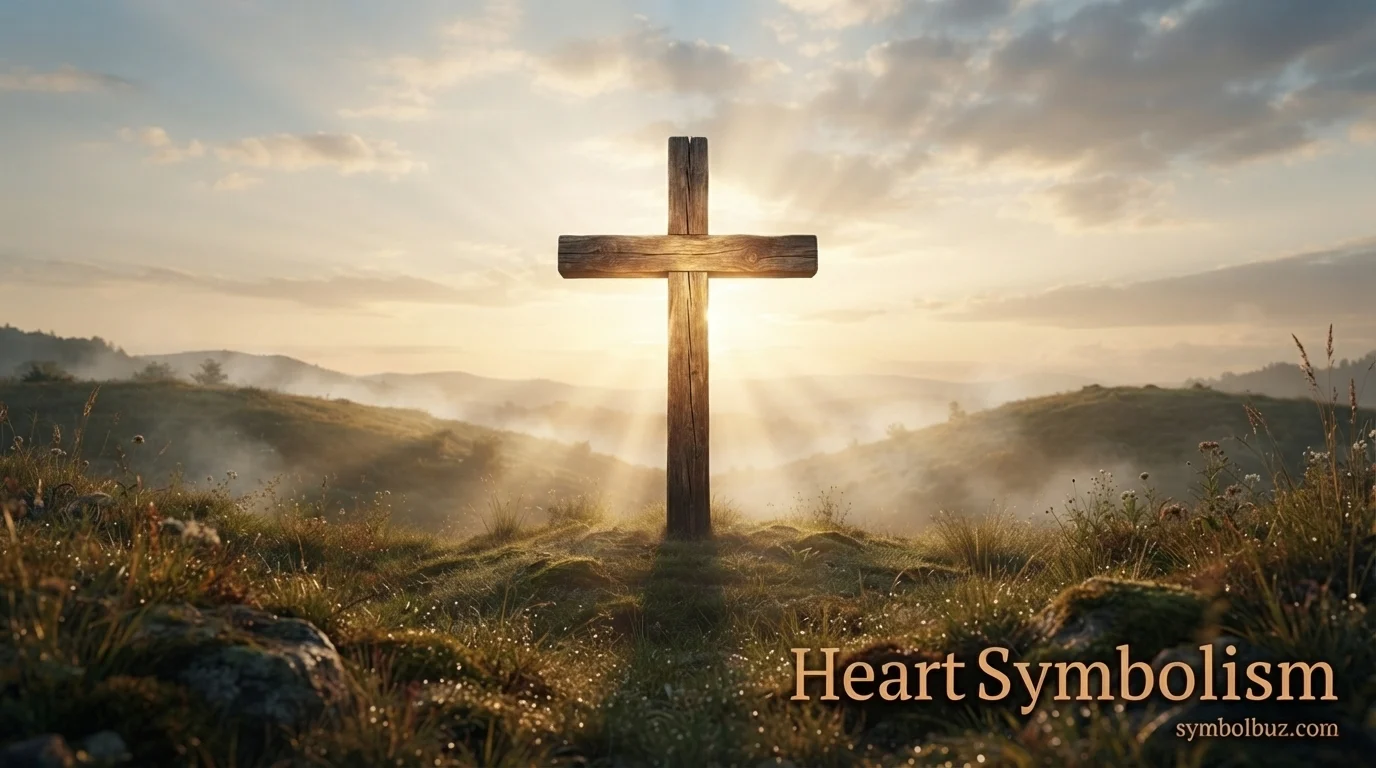
The cross symbolism has remained one of the most recognizable and meaningful symbols in human history. Most strongly associated with Christianity, the cross can represent faith, sacrifice, redemption, hope, protection, and spiritual transformation. Its meaning can also vary depending on culture, historical period, personal belief, and the specific design of the cross.
Today, people encounter crosses in churches, jewelry, artwork, memorials, architecture, literature, and personal expressions of faith. Understanding cross symbolism offers a deeper look at how a simple shape can carry powerful emotional and spiritual meaning.
Cross Symbolism Meaning (Clear Definition)
At its simplest, cross symbolism refers to the meanings associated with a shape formed by two intersecting lines. In Christianity, the cross primarily represents the crucifixion of Jesus Christ and the promise of salvation.
The symbol commonly communicates several interconnected ideas:
- Faith — devotion to religious belief
- Sacrifice — giving something valuable for a greater purpose
- Redemption — freedom from sin and spiritual restoration
- Hope — trust in life, salvation, or renewal
- Love — selfless love and compassion
- Protection — a symbol of spiritual strength for many believers
- Resurrection — victory over death and the promise of eternal life
Although the Christian cross is its most familiar form, cross-shaped symbols existed in various cultures before Christianity. Their meanings were not necessarily connected to Jesus or Christian theology.
What Does Cross Symbolism Represent?
The cross represents different ideas depending on its religious, cultural, and personal context.
Faith and Devotion
For Christians, wearing or displaying a cross can express commitment to Christian faith. It may serve as a visible reminder of religious teachings and a personal relationship with God.
Sacrifice and Selflessness
Because of its connection with the crucifixion, the cross often symbolizes sacrifice. It can remind believers of the suffering and self-giving associated with Christ’s death.
Redemption and Forgiveness
Another important meaning is redemption. The cross is closely connected with the Christian belief that Christ’s sacrifice provides a path toward forgiveness and reconciliation with God.
Hope and New Life
The cross is not only associated with suffering. Through its connection with the resurrection, it can also represent hope, renewal, victory, and new spiritual life.
Strength During Difficult Times
Some people view the cross as a source of courage when facing hardship. Its symbolism can provide a reminder that suffering does not necessarily represent the end of the story.
Spiritual Meaning of Cross Symbolism
Spiritually, the cross can symbolize the meeting of earthly experience and divine purpose. Its vertical and horizontal lines are sometimes interpreted symbolically, although these interpretations vary among traditions.
The vertical line may be understood as representing a connection between humanity and the divine, while the horizontal line can suggest relationships among people and the wider world.
Together, the two directions can evoke ideas of:
- Connection between heaven and earth
- Relationship between God and humanity
- Compassion toward others
- Balance between spiritual and physical life
- Sacrifice followed by transformation
- Faith during periods of uncertainty
For many believers, the spiritual meaning of the cross is ultimately centered on Christ rather than on the geometry of the symbol itself.
Biblical / Religious Meaning of Cross Symbolism
Within Christianity, the cross is central to the story of Jesus Christ. The New Testament describes Jesus being crucified, and the cross consequently became a foundational symbol of Christian faith.
The Apostle Paul placed strong emphasis on the significance of Christ’s crucifixion. In Christian theology, the cross is associated with salvation, reconciliation, forgiveness, and God’s love.
The cross therefore carries a dual message: it recalls suffering and death while also pointing toward resurrection and eternal hope.
Different Christian traditions may emphasize particular aspects of the symbol. Catholics and Orthodox Christians commonly use the crucifix, which includes a representation of Christ’s body, while many Protestant traditions frequently use an empty cross to emphasize the resurrection.
Outside Christianity, cross-like forms have appeared in numerous cultures and religions. However, similar shapes do not automatically share the Christian meaning. Their interpretation depends heavily on historical and cultural context.
Cross Symbolism in History and Culture
The history of cross symbolism is broader than Christianity.
Cross-like designs appeared in ancient cultures as decorative, religious, astronomical, or symbolic forms. One well-known example is the ankh of ancient Egypt, which resembles a cross with a loop at the top and was associated with life.
The Greek cross, with four arms of approximately equal length, became an important Christian design. The Latin cross, with a longer vertical section below the intersection, became especially recognizable in Western Christianity.
The Celtic cross, often featuring a circle around the intersection, developed within the cultural and artistic traditions of Celtic Christianity. It has become strongly associated with Ireland and Celtic heritage.
Over centuries, crosses have appeared in:
- Religious architecture
- Grave markers and memorials
- Jewelry
- Paintings and sculpture
- National and cultural imagery
- Manuscripts and illuminated texts
- Personal devotional objects
The meaning of a particular cross should always be considered within its historical setting.
Cross Symbolism in Literature and Art
Artists and writers have used the cross to communicate powerful themes such as suffering, faith, morality, sacrifice, conflict, and redemption.
In religious art, the cross frequently appears in scenes depicting the crucifixion, resurrection, saints, or moments of devotion. It can create an immediate visual connection with Christian beliefs.
In literature, the cross may function as both a literal religious object and a metaphor. A character carrying a cross, for example, may symbolize enduring hardship, accepting responsibility, or facing a difficult burden.
The phrase “bearing one’s cross” has become a broader metaphor for enduring personal difficulties. In this context, the cross can represent responsibility, suffering, perseverance, or an unavoidable challenge.
Dream Meaning of Cross Symbolism
Dreams involving a cross can have different meanings depending on the dreamer’s beliefs, emotions, and circumstances.
For a religious person, seeing a cross in a dream may represent faith, spiritual guidance, prayer, protection, or a desire for reassurance.
Other interpretations may include:
- Seeing a cross: spiritual reflection or a search for meaning
- Wearing a cross: personal faith or commitment
- Finding a cross: discovering hope or guidance
- Carrying a cross: dealing with responsibility or hardship
- Broken cross: uncertainty, conflict, or changing beliefs
- Bright or glowing cross: hope, comfort, or spiritual encouragement
Dream symbolism is personal rather than universal. The emotions experienced during the dream are often as important as the image itself.
Modern Meaning of Cross Symbolism
In modern life, the cross remains a powerful religious and cultural symbol.
Many Christians wear cross necklaces, bracelets, rings, or other jewelry as expressions of faith. Churches commonly place crosses prominently on buildings, altars, and religious artwork.
At the same time, the symbol can have personal meanings beyond public religious identity. Someone may wear a cross to remember a loved one, mark an important spiritual experience, or express hope during a difficult period.
The cross can also appear in fashion and popular culture. In these settings, its meaning may be religious, aesthetic, historical, cultural, or deliberately symbolic.
Because the cross has deep religious significance for billions of people, using it respectfully requires awareness of its Christian context.
Common Types of Crosses and Their Meanings
| Cross Type | Common Symbolic Association |
|---|---|
| Latin Cross | Christianity, sacrifice, salvation |
| Greek Cross | Christian faith, balance, tradition |
| Celtic Cross | Celtic Christianity, heritage, spirituality |
| Crucifix | Christ’s sacrifice and crucifixion |
| Orthodox Cross | Eastern Christian tradition |
| Tau Cross | Religious tradition, service, and historical Christian symbolism |
| Ankh | Life and ancient Egyptian religious symbolism |
These associations are general rather than absolute. A cross can have different meanings depending on its design, location, historical period, and the person using it.
Why Is the Cross So Powerful as a Symbol?
The cross combines simplicity with a profound historical story. Its shape is easy to recognize, while its Christian meaning connects it with some of the central themes of Christian belief.
It can represent suffering without ending with suffering. It can recall death while also pointing toward resurrection. It can symbolize sacrifice while simultaneously expressing love and hope.
That combination helps explain why the cross has remained influential for centuries.
Frequently Asked Questions About Cross Symbolism
What is the main meaning of cross symbolism?
The main Christian meaning of the cross is the crucifixion of Jesus Christ and the salvation associated with it. It also represents faith, sacrifice, redemption, love, and hope.
What does a cross symbolize spiritually?
Spiritually, a cross can symbolize connection with God, faith during hardship, sacrifice, transformation, and hope. Its exact meaning depends on the person’s religious tradition and personal beliefs.
What does wearing a cross symbolize?
Wearing a cross commonly expresses Christian faith and devotion. For some people, it also serves as a reminder of hope, protection, personal values, or spiritual commitment.
What does a cross mean in a dream?
A cross in a dream may symbolize faith, guidance, responsibility, hardship, hope, or spiritual reflection. The meaning depends strongly on the dreamer’s feelings and circumstances.
Why is the cross important in Christianity?
The cross is important because it represents the crucifixion of Jesus Christ, a central event in Christian theology. It is closely connected with teachings about salvation, forgiveness, resurrection, and God’s love.
Conclusion
Cross symbolism carries a remarkable range of meanings, but its central Christian associations remain faith, sacrifice, redemption, love, and hope. Across history, the cross has moved from an ancient geometric form into one of the world’s most recognizable religious symbols.
If found in a church, worn as jewelry, represented in artwork, or encountered in a dream, the cross can invite reflection on suffering, spiritual strength, compassion, and the possibility of renewal.

I am Jasmine Marie, an administrator at SymbolBuz. I love exploring symbols and sharing their meanings to help readers understand their deeper stories, messages, and significance.