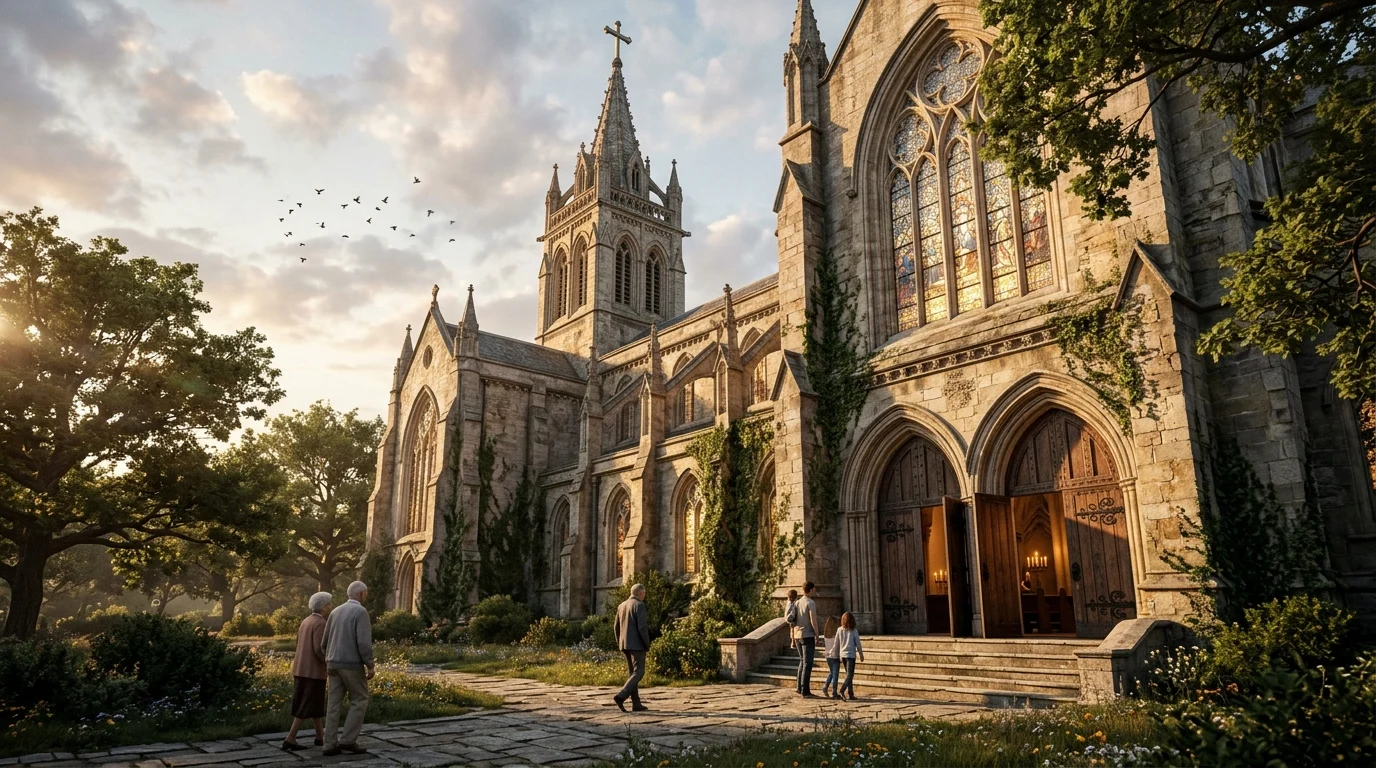
Church symbolism represents faith, worship, spiritual guidance, community, hope, and the connection between humanity and God. Throughout history, churches have served as important places where people gather to pray, seek comfort, celebrate religious traditions, and strengthen their spiritual beliefs. Their architecture, decorations, symbols, and sacred objects often communicate deeper meanings that go beyond their physical appearance.
Understanding church symbolism helps reveal how religious spaces express spiritual values and cultural traditions. From the church building itself to its stained-glass windows, crosses, bells, and altars, every element can carry a meaningful message.
Whether you encounter a church in everyday life, religious artwork, literature, or a dream, its symbolism often connects with faith, inner peace, belonging, and spiritual reflection.
Church Symbolism Meaning (Clear Definition)
Church symbolism refers to the spiritual, religious, and cultural meanings associated with churches, their architecture, and the objects found inside them.
A church commonly symbolizes:
- Faith: Trust in God and commitment to religious beliefs.
- Worship: A place dedicated to prayer and devotion.
- Community: Unity, friendship, and shared spiritual values.
- Hope: Comfort and encouragement during difficult times.
- Guidance: Spiritual direction and moral understanding.
- Peace: A quiet environment for reflection and prayer.
- Salvation: The Christian belief in redemption through Jesus Christ.
A church is more than a physical building. For many Christians, it represents a spiritual home where individuals connect with God and fellow believers.
Its meaning can also differ depending on religious traditions, architectural styles, historical periods, and personal experiences.
What Does Church Symbolism Represent?
Church symbolism carries several important meanings that reflect the relationship between faith, spirituality, and human life.
Here are some of its most common interpretations.
1. Faith and Devotion
A church often represents a person’s faith and dedication to God. It provides a place where believers gather for worship, prayer, and religious ceremonies.
Its presence can remind people to remain connected to their spiritual values.
2. Community and Belonging
Churches bring people together through shared beliefs and traditions. Religious gatherings create opportunities for friendship, support, and cooperation.
Therefore, a church can symbolize unity and a sense of belonging.
3. Hope and New Beginnings
For many people, entering a church represents an opportunity to find hope during challenging moments.
Churches are also associated with important life events, including baptisms, weddings, and celebrations. These occasions connect church symbolism with renewal and new beginnings.
4. Protection and Safety
Church buildings have traditionally provided shelter, comfort, and support to communities.
Symbolically, they can represent a safe place where people seek encouragement, forgiveness, and emotional strength.
5. Wisdom and Spiritual Guidance
Churches often represent religious teachings, moral principles, and spiritual knowledge.
Their symbolism encourages people to reflect on their actions, develop compassion, and make thoughtful decisions.
Common Symbolic Meanings of Church Elements
| Church element | Symbolic meaning |
|---|---|
| Church building | Faith and spiritual belonging |
| Cross | Sacrifice, salvation, and Christianity |
| Altar | Worship and devotion |
| Bell | Spiritual calling and community |
| Stained glass | Biblical stories and divine light |
| Candles | Prayer, hope, and remembrance |
| Church doors | Welcome and spiritual opportunities |
| Steeple | Aspiration and connection with heaven |
| Pews | Community and shared worship |
| Baptismal font | Spiritual cleansing and new life |
These meanings may vary across Christian denominations and cultural traditions.
Spiritual Meaning of Church Symbolism
The spiritual meaning of church symbolism centers on faith, divine connection, inner peace, and the search for a meaningful life.
For many believers, a church represents a place where the physical and spiritual aspects of life come together.
Connection With God
A church provides an environment for prayer, worship, and reflection. Its spiritual symbolism reminds believers of their relationship with God.
It can also represent the desire to strengthen faith and develop a deeper understanding of religious teachings.
Inner Peace and Healing
Churches are often associated with comfort during difficult experiences.
People may visit them when facing grief, uncertainty, disappointment, or personal struggles. In this context, a church symbolizes emotional support, forgiveness, and hope.
Spiritual Growth
Religious teachings encourage individuals to develop patience, kindness, humility, and compassion.
A church can therefore symbolize a journey toward spiritual maturity and personal transformation.
Forgiveness and Redemption
Christian traditions place significant importance on forgiveness and redemption.
For this reason, churches often represent opportunities for repentance, reconciliation, and renewed commitment to faith.
Light and Divine Guidance
Light is a powerful symbol in Christian religious spaces. Candles, stained-glass windows, and illuminated altars can represent divine presence, truth, and spiritual understanding.
Together, these elements communicate the idea of finding direction through faith.
Biblical / Religious Meaning of Church Symbolism
Church symbolism has a particularly important place in Christianity. In the Bible, the word church does not refer only to a physical building. It also describes the community of people who follow Jesus Christ.
This distinction gives church symbolism a deeper religious meaning.
The Church as the Body of Christ
In 1 Corinthians 12:27, Paul describes believers as the body of Christ, with each person serving an important role.
This teaching connects church symbolism with unity, cooperation, and shared responsibility.
It suggests that the spiritual church is made up of people rather than simply walls and buildings.
The Church as God’s House
Many Christian traditions describe a church building as God’s house or a sacred place for worship.
It represents devotion, prayer, and the importance of gathering together to honor God.
However, Christian teachings also emphasize that God’s presence is not limited to a particular building.
The Church as a Place of Worship
Churches provide spaces for important religious activities, including:
- Sunday worship services.
- Prayer and Bible study.
- Baptism and communion.
- Weddings and funerals.
- Religious celebrations.
- Community support and fellowship.
These activities strengthen the connection between church symbolism and Christian life.
The Church as a Spiritual Family
Christian communities often view themselves as a spiritual family.
This interpretation highlights love, kindness, mutual support, and responsibility toward others.
Consequently, church symbolism can represent the importance of living according to Christian values both inside and outside religious spaces.
Church Symbolism in History and Culture
Church symbolism has developed over many centuries. As Christianity spread across different regions, churches became important centers of religion, education, architecture, art, and community life.
Their physical designs often reflected the beliefs and artistic traditions of their historical periods.
Early Christian Churches
Early Christian communities initially gathered in private homes and other meeting places.
As Christianity became more established, dedicated buildings developed into recognizable places of worship.
These spaces symbolized religious identity, community unity, and devotion.
Medieval Church Architecture
During the medieval period, churches and cathedrals became major architectural achievements.
Cologne Medieval Churches Tour | Private Guide & History
A Brief Guide to Greek Architecture
Justin R. Hawkins, PhD | Postdoctoral Researcher in Bioethics, Columbia University Medical School
8
Gothic architecture introduced pointed arches, tall ceilings, large windows, and impressive towers.
These architectural features often created a feeling of elevation and wonder. Their upward designs could symbolize humanity’s desire to reach toward heaven.
Church Bells and Community Life
Church bells historically served practical and symbolic purposes.
They announced worship services, marked important occasions, and sometimes communicated emergencies.
Culturally, bells became associated with celebration, remembrance, and the shared identity of a community.
Churches Around the World
Different Christian communities developed distinctive architectural and decorative traditions.
Catholiques africains : croissance exponentielle
8
For example:
- Orthodox churches: Often feature icons, domes, and elaborate religious decorations.
- Catholic churches: Frequently include altars, statues, candles, and sacred artwork.
- Protestant churches: Many emphasize simplicity, Bible-centered worship, and congregational participation.
- African Christian churches: Often incorporate local artistic traditions, music, and community expressions.
- South Asian churches: May combine Christian architectural elements with regional materials and artistic influences.
These differences demonstrate how church symbolism reflects both religious beliefs and cultural identity.
Church Symbolism in Literature and Art
Churches have appeared throughout literature, painting, sculpture, poetry, and other artistic traditions.
Artists and writers often use church imagery to explore faith, morality, hope, guilt, redemption, and human struggles.
Churches as Symbols of Hope
In literature, a church may represent a place where characters find comfort after experiencing hardship.
Its presence can suggest forgiveness, spiritual renewal, or the possibility of a better future.
Churches as Symbols of Tradition
Writers sometimes use churches to represent established beliefs, cultural identity, and inherited values.
A historic church can also symbolize the relationship between past generations and modern society.
Religious Architecture in Art
Artists frequently use church buildings to communicate spiritual ideas.
Paul Vredeman de Vries, Interior of a Gothic Cathedral, 1612 | LACMA Collections
e-arthistory: BELLINI’s SAN ZACCARIA – is it JEROME or ZACHARIAS?
Church Photo Backdrop Gothic Stained Glass Window Backdrop BRP12-704
9
Common artistic elements include:
- Crosses: Representing sacrifice and Christian faith.
- Angels: Symbolizing divine protection and spiritual messages.
- Light: Suggesting truth, hope, and divine presence.
- Church towers: Representing aspiration and spiritual elevation.
- Altars: Communicating devotion and sacred commitment.
In some stories, a church may also represent conflict between personal desires and religious expectations. Its meaning depends on the artist’s message and the surrounding narrative.
Dream Meaning of Church Symbolism
Dreaming about a church can have different interpretations depending on your emotions, personal beliefs, and the details of the dream.
For some people, a church dream may reflect faith, inner peace, a desire for guidance, or thoughts about important life decisions.
However, dreams do not have universally established meanings, and their interpretations should not be treated as predictions.
Dreaming of Entering a Church
Entering a church may symbolize a desire for comfort, spiritual connection, or emotional stability.
It can reflect a period of self-reflection or a search for direction.
Dreaming of an Empty Church
An empty church may represent loneliness, uncertainty, or a desire to reconnect with something meaningful.
Your feelings during the dream can help provide additional context.
Dreaming of Praying in a Church
Praying in a church may reflect hope, gratitude, forgiveness, or a need for support.
It can also represent a desire to strengthen your beliefs.
Dreaming of a Beautiful Church
A beautiful church may symbolize inspiration, peace, spiritual appreciation, or a positive connection with religious traditions.
Dreaming of an Old or Damaged Church
An old or damaged church may reflect changing beliefs, unresolved memories, or concerns about personal values.
It may encourage you to think about what needs attention in your life.
Modern Meaning of Church Symbolism
In modern society, church symbolism continues to represent faith, community, cultural heritage, and spiritual identity.
Although people’s relationships with organized religion differ, churches remain meaningful places for millions of individuals around the world.
A Symbol of Community Support
Modern churches often organize charity programs, educational activities, food assistance, and community events.
These activities connect church symbolism with generosity, cooperation, and social responsibility.
A Symbol of Cultural Heritage
Historic churches preserve important examples of architecture, painting, sculpture, and craftsmanship.
Even people who do not regularly attend religious services may appreciate these buildings as cultural landmarks.
A Place for Reflection
Many people visit churches to experience silence, appreciate religious artwork, or spend time reflecting on personal experiences.
For them, church symbolism can represent a peaceful environment away from everyday distractions.
A Symbol of Faith in Changing Times
Modern interpretations of church symbolism also involve questions about identity, belonging, tradition, and personal belief.
For some, the church represents a lifelong spiritual commitment. For others, it represents family history, cultural traditions, or an opportunity to explore religious ideas.
Ultimately, its meaning depends on individual experiences and the beliefs of the surrounding community.
FAQS:
1. What does a church symbolize spiritually?
A church spiritually symbolizes faith, divine connection, worship, forgiveness, and inner peace. It can also represent spiritual growth and a sense of belonging.
2. What does a church represent in Christianity?
In Christianity, a church represents both a place of worship and the community of believers who follow Jesus Christ. It symbolizes unity, devotion, fellowship, and the body of Christ.
3. What does a church symbolize in a dream?
A church in a dream may represent faith, guidance, comfort, or a desire for spiritual connection. Its interpretation depends on the dream’s details and the dreamer’s personal experiences.
4. Why is the church building considered sacred?
Church buildings are considered sacred because Christians dedicate them to worship, prayer, religious ceremonies, and spiritual gatherings. Their importance comes from their religious purpose and the beliefs of the community.
5. What do church bells symbolize?
Church bells commonly symbolize spiritual calling, worship, celebration, remembrance, and community unity. Their meaning can vary according to local traditions and religious practices.
Conclusion
Church symbolism represents much more than religious architecture. It reflects faith, hope, worship, community, forgiveness, and the search for spiritual meaning. From the cross and altar to church bells and stained-glass windows, every element can communicate important religious and cultural ideas. Ultimately, a church symbolizes a place where people come together to strengthen their beliefs, find comfort, and connect with something greater than themselves.

I explore the meanings and stories behind symbols, helping readers understand their cultural, spiritual, and everyday significance through clear, engaging, and meaningful insights.