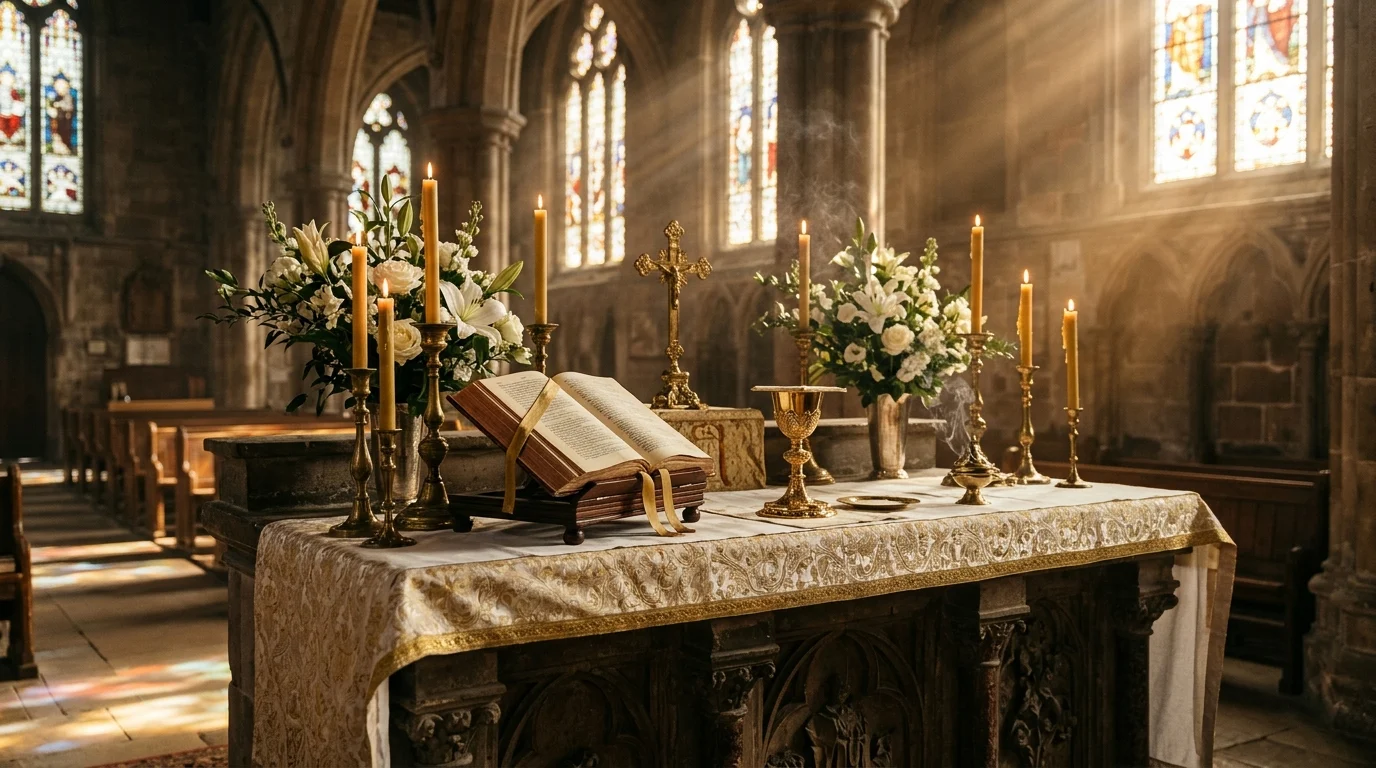
Altar symbolism represents devotion, faith, sacrifice, spiritual connection, and the desire to connect with something greater than ourselves. Throughout history, altars have served as sacred spaces where people express gratitude, offer prayers, perform religious ceremonies, and reflect on important life experiences. They often symbolize the meeting point between the physical and spiritual worlds.
From ancient temples to modern homes, altars hold deep meaning across different religions and cultures. Their appearance, decorations, and purpose may vary, but their central message often remains connected to reverence, hope, and spiritual commitment. Understanding altar symbolism helps us appreciate why these sacred structures continue to inspire people around the world.
Altar Symbolism Meaning (Clear Definition)
Altar symbolism refers to the deeper spiritual, religious, and cultural meanings associated with an altar. An altar is a designated place where people perform sacred rituals, present offerings, pray, or express devotion.
In many traditions, an altar represents a connection between humanity and the divine. It creates a special space for reflection, worship, and meaningful spiritual practices.
An altar can symbolize several important ideas:
- Faith: A visible expression of religious belief and devotion.
- Sacrifice: The willingness to give something meaningful for a higher purpose.
- Prayer: A dedicated space for communication with the divine.
- Purification: A desire to release negativity and seek spiritual renewal.
- Gratitude: An opportunity to express appreciation and thankfulness.
- Transformation: A symbolic place for personal growth and spiritual change.
- Connection: A meeting point between the human and sacred worlds.
Although altars are commonly associated with religion, they can also represent personal values, remembrance, and emotional healing.
What Does Altar Symbolism Represent?
Altar symbolism represents different ideas depending on the religion, culture, and purpose of the sacred space. Its meaning often comes from the activities performed there and the objects placed upon it.
Here are some of its most recognized symbolic interpretations.
1. Faith and Devotion
An altar is often a physical expression of belief. People gather around it to pray, worship, and strengthen their relationship with their faith.
It reminds individuals to remain connected to their spiritual values.
2. Sacrifice and Offering
In many ancient and religious traditions, altars were places where people presented offerings to deities or spiritual powers.
These offerings represented gratitude, obedience, commitment, or the desire to seek divine favor.
3. Spiritual Connection
An altar can represent a bridge between the physical world and the spiritual realm. It provides a dedicated setting for prayer, meditation, and sacred ceremonies.
4. Purification and Renewal
Some traditions associate altars with cleansing, forgiveness, and fresh beginnings. Rituals performed around an altar may symbolize leaving past mistakes behind and beginning a new spiritual journey.
5. Protection and Blessings
In certain religious and cultural practices, altars represent a place where people seek protection, guidance, and blessings for themselves and their families.
Spiritual Meaning of Altar Symbolism
The spiritual meaning of altar symbolism is closely connected to inner peace, devotion, surrender, and personal transformation.
Spiritually, an altar encourages people to pause and focus on what matters most. It can become a meaningful place for prayer, meditation, gratitude, and self-reflection.
A Sacred Space for Inner Peace
An altar creates a peaceful environment away from everyday distractions. People may use this space to reflect on their thoughts, express gratitude, and develop a stronger sense of purpose.
A Symbol of Spiritual Surrender
In many spiritual traditions, placing an offering on an altar represents surrendering personal desires or concerns to a higher power.
This practice can symbolize trust, humility, and acceptance.
A Place of Transformation
Altars are sometimes associated with important life changes. They may represent the decision to leave behind negative habits, embrace new beliefs, or begin a meaningful journey.
A Reminder of Higher Values
A personal altar may contain candles, meaningful objects, photographs, flowers, or religious symbols. These items remind individuals of their beliefs, intentions, and spiritual priorities.
Ultimately, the spiritual meaning of an altar depends on the beliefs and intentions of the people who use it.
Biblical / Religious Meaning of Altar Symbolism
Altar symbolism has an important place in the Bible and many other religious traditions. In Christianity, Judaism, Hinduism, Buddhism, and various Indigenous traditions, altars serve different purposes while maintaining connections to sacred practices.
Altar Symbolism in the Bible
In the Bible, altars frequently represent worship, sacrifice, covenant, gratitude, and communication with God.
Several important biblical figures built altars to honor God and remember significant spiritual experiences.
For example:
- Noah: Built an altar after the flood and offered sacrifices to God as an expression of gratitude (Genesis 8:20).
- Abraham: Built altars in response to God’s promises and guidance (Genesis 12:7–8).
- Isaac: Built an altar at Beersheba and called upon the name of the Lord (Genesis 26:25).
- Jacob: Associated altars with important encounters and spiritual commitments (Genesis 35:1–7).
In the Old Testament, the altar was also central to Israelite worship and sacrificial practices.
In Christianity, the altar is commonly associated with prayer, the Eucharist, remembrance of Jesus Christ, and the sacrifice of Christ.
Altar Symbolism in Judaism
In Judaism, altars were important features of ancient Temple worship. They were associated with offerings, religious obligations, and the relationship between God and the Jewish people.
The Temple in Jerusalem held a central place in these practices.
Altar Symbolism in Hinduism
In Hindu traditions, a home shrine or puja altar provides a sacred place for worship and devotion.
People may place statues or images of deities, flowers, incense, lamps, and offerings on the altar.
These objects express respect, gratitude, and devotion.
Altar Symbolism in Buddhism
Buddhist altars often contain images of the Buddha, candles, flowers, incense, and other meaningful objects.
They symbolize mindfulness, compassion, wisdom, impermanence, and respect for Buddhist teachings.
Although religious interpretations differ, altars commonly provide a dedicated setting for spiritual practice and reflection.
Altar Symbolism in History and Culture
Altars have existed in many civilizations for thousands of years. Their forms and purposes developed according to the religious beliefs, traditions, and social structures of different communities.
Italy, Campania, Pompeii. Ruins of Pompeii archaeological site.
Bhimonee Decor Brass Diya Collection: Lighting Your Mandir the Way It
9
Ancient Egyptian Altars
In ancient Egypt, offerings were presented in temples and sacred spaces to honor gods and support religious rituals.
Altars and offering tables were associated with divine protection, remembrance, and the relationship between humans and deities.
Ancient Greek and Roman Altars
Ancient Greek and Roman communities used altars for offerings, sacrifices, and public religious ceremonies.
These structures were often located in temples, courtyards, and other sacred places.
They represented devotion to gods and the importance of religious traditions in community life.
Indigenous Cultural Traditions
Various Indigenous communities have maintained sacred ceremonial spaces where offerings, prayers, and traditional rituals take place.
The objects and practices differ significantly between cultures. Therefore, their meanings should be understood within their specific cultural traditions rather than treated as universal symbols.
Altars in Modern Religious Communities
Today, altars remain important in churches, temples, shrines, and private homes.
Some serve large religious communities, while others provide individuals and families with a personal place for worship and remembrance.
Altar Symbolism in Literature and Art
Altars appear in paintings, poetry, literature, architecture, and other creative forms. Artists often use them to communicate ideas that go beyond religious worship.
In visual art, an altar may represent holiness, sacrifice, devotion, or the presence of something sacred.
Altars as Symbols of Sacrifice
Writers and artists sometimes use altars to explore the idea of giving something valuable for love, faith, or a greater purpose.
An altar can represent the emotional cost of devotion or commitment.
Altars as Symbols of Hope
In literature, an altar may represent a place where characters seek forgiveness, guidance, or a new beginning.
It can also suggest the possibility of healing after difficult experiences.
Altars in Religious Paintings
Religious paintings frequently portray altars surrounded by candles, flowers, sacred objects, or worshippers.
These visual details help communicate reverence, spiritual importance, and religious identity.
Altars as Metaphors
Outside religious settings, writers sometimes use the word altar metaphorically.
For example, someone may describe a person, belief, or ambition as an altar to suggest deep devotion or sacrifice.
Dream Meaning of Altar Symbolism
Dreaming about an altar may symbolize spiritual reflection, personal beliefs, sacrifice, or a desire for guidance. However, dream meanings are subjective and depend on personal experiences, emotions, and cultural background.
Different altar-related dreams may suggest different interpretations.
The Sacred Flame: The Ancient History of Candle Magic & Crystal Candles | Divine Warrior
Dreaming of a Beautiful Altar
A beautiful altar may represent inner peace, hope, gratitude, or a desire to strengthen your spiritual connection.
Dreaming of Praying at an Altar
Praying at an altar may reflect a need for comfort, guidance, forgiveness, or emotional support during a challenging period.
Dreaming of a Broken Altar
A damaged altar may symbolize disappointment, uncertainty, or a feeling of disconnection from personal beliefs and values.
Dreaming of Lighting Candles on an Altar
Lighting candles may represent hope, inspiration, spiritual awareness, or the beginning of a new chapter.
Dreaming of an Empty Altar
An empty altar may reflect a search for meaning, a desire for direction, or a period of questioning personal beliefs.
Rather than treating these interpretations as predictions, consider how the dream connects with your current emotions and life circumstances.
Modern Meaning of Altar Symbolism
In modern life, altar symbolism extends beyond traditional religious ceremonies. Many people create personal sacred spaces to express their beliefs, remember loved ones, or develop healthier daily routines.
🔮 Cómo crear tu espacio sagrado para manifestar (altar espiritual mini – Aurius
Catholic Wall Altar Small Living Room: 5 Space Fixes
Funeral & Memorial Songs to Honor a Loved One | One Special Song
11
Personal Growth and Mindfulness
A meditation altar can provide a quiet place for reflection, breathing exercises, and mindfulness.
It may include objects that encourage calmness, gratitude, and positive intentions.
Family and Remembrance
Some families create memorial altars to honor relatives and preserve meaningful memories.
Photographs, flowers, candles, and personal belongings can represent love, respect, and remembrance.
Love and Commitment
In wedding ceremonies, an altar often symbolizes commitment, unity, and the beginning of a shared journey.
It represents the importance of promises and relationships.
Personal Values and Intentions
A modern personal altar may represent important goals, beliefs, and aspirations.
For some people, it becomes a daily reminder to live with kindness, patience, gratitude, and purpose.
Common Symbols and Objects Found on an Altar
The objects placed on an altar often carry their own symbolic meanings. Their interpretations vary according to religious and cultural traditions.
| Altar Object | Common Symbolic Meaning |
|---|---|
| Candles | Hope, light, faith, and guidance |
| Flowers | Beauty, love, purity, and renewal |
| Incense | Prayer, devotion, and sacred atmosphere |
| Religious statues | Faith, divine presence, and devotion |
| Holy books | Wisdom, spiritual teachings, and guidance |
| Water | Purification, cleansing, and renewal |
| Fruits | Gratitude, abundance, and offerings |
| Cross | Christianity, sacrifice, and salvation |
| Photographs | Memory, love, and remembrance |
These meanings are common interpretations rather than universal definitions. The significance of an object depends on the tradition in which it is used.
FAQS:
1. What does an altar symbolize spiritually?
An altar spiritually symbolizes devotion, faith, sacrifice, inner peace, and connection with the divine. It can also represent personal transformation and gratitude.
2. What does an altar represent in Christianity?
In Christianity, an altar represents worship, prayer, remembrance, and the sacrifice of Jesus Christ. It also serves as an important place for celebrating the Eucharist in many Christian traditions.
3. What does a candle on an altar symbolize?
A candle commonly symbolizes hope, spiritual light, guidance, faith, and remembrance. Its meaning may vary depending on the religious or cultural practice.
4. What does building an altar symbolize?
Building an altar can symbolize devotion, commitment, gratitude, and the desire to create a dedicated space for spiritual reflection or worship.
5. What does an altar symbolize in dreams?
An altar in a dream may symbolize spiritual searching, personal values, sacrifice, or a desire for guidance. Its interpretation depends on the dreamer’s feelings and personal circumstances.
Conclusion
Altar symbolism carries powerful meanings connected to faith, devotion, sacrifice, gratitude, and spiritual transformation. Across different religions and cultures, altars provide meaningful spaces for worship, reflection, and remembrance.
Whether found in an ancient temple, a modern church, or a peaceful home, an altar reminds people of the values and beliefs that give their lives meaning. Ultimately, its deepest symbolism lies in the intention, devotion, and respect people bring to this sacred space.

I explore the meanings, history, and cultural significance behind symbols, helping readers understand how symbols connect with ideas, emotions, traditions, and everyday life.