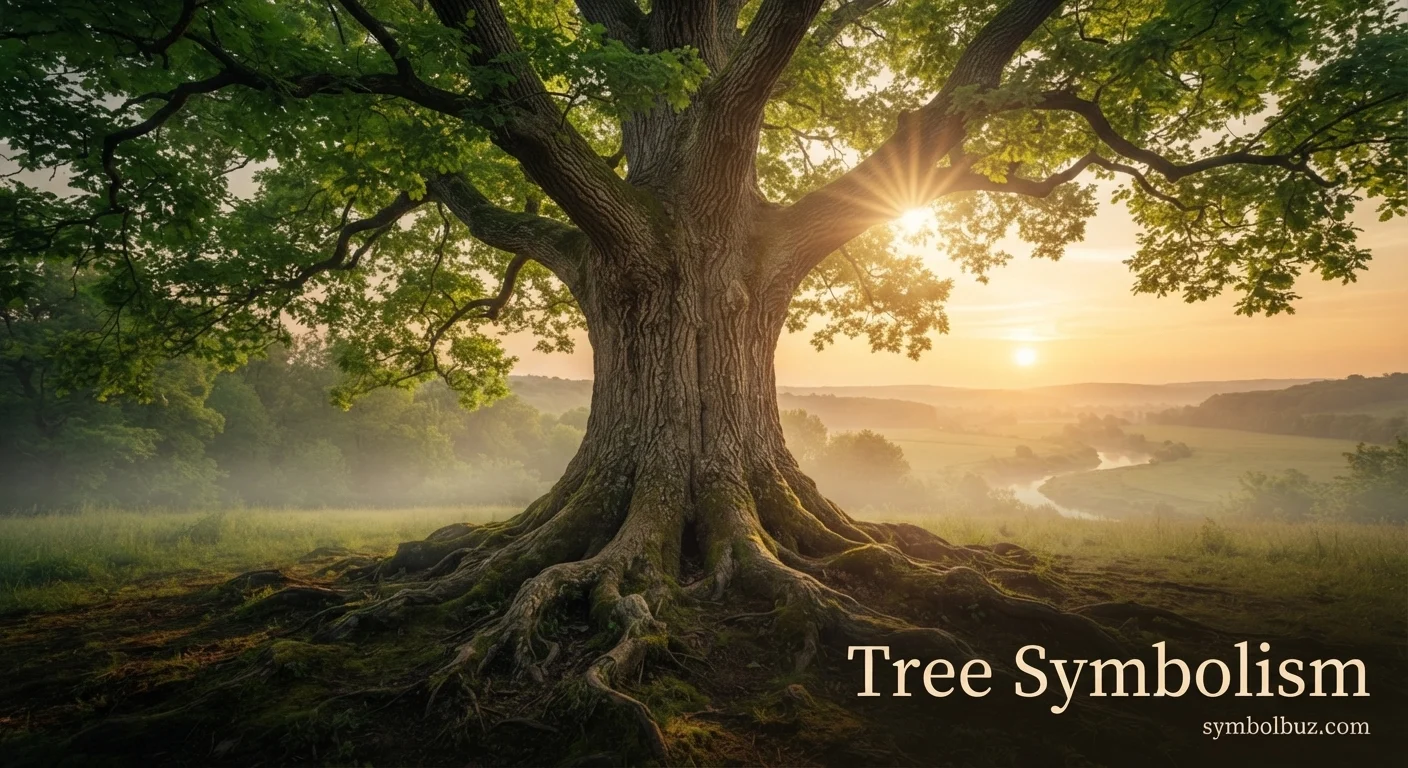
Tree symbolism is deeply connected to life, growth, strength, wisdom, and connection. Across cultures and generations, trees have represented the journey of life because they grow from roots hidden in the earth while reaching upward toward the sky. Their changing seasons also make them powerful symbols of renewal, endurance, and transformation.
Whether you are interested in the spiritual meaning of trees, their appearance in dreams, religious traditions, or their role in art and literature, trees carry layers of meaning that remain relevant today.
Tree Symbolism Meaning
Tree symbolism refers to the meanings and ideas people associate with trees based on their physical characteristics, life cycle, cultural traditions, and spiritual beliefs.
At its simplest, a tree can symbolize life, growth, stability, strength, wisdom, and connection. Its roots suggest foundations and heritage, while its branches can represent expansion, relationships, aspirations, and possibilities.
The meaning can also change depending on the type of tree, its condition, and the situation in which it appears.
Common Tree Symbolism Meanings
| Tree Symbol | Common Meaning |
|---|---|
| Roots | Family, heritage, stability, foundation |
| Trunk | Strength, resilience, identity |
| Branches | Growth, relationships, possibilities |
| Leaves | Renewal, change, vitality |
| Fruit | Abundance, achievement, fertility |
| Seeds | Potential, beginnings, future growth |
| Ancient tree | Wisdom, endurance, experience |
| Fallen tree | Transformation, endings, mortality |
What Does Tree Symbolism Represent?
Trees can represent many aspects of human life. Their symbolism often comes from observing how they survive, grow, reproduce, and adapt to changing conditions.
1. Growth and Personal Development
A tree begins as a small seed and gradually develops into something much larger. For this reason, it often symbolizes personal growth, learning, maturity, and progress.
2. Strength and Resilience
Trees withstand wind, storms, heat, cold, and changing seasons. This makes them natural symbols of endurance and resilience.
3. Stability and Grounding
Deep roots provide support and nourishment. Symbolically, roots can represent family, identity, values, memories, and the foundations that keep a person grounded.
4. Wisdom and Knowledge
Older trees are often associated with wisdom because they survive for decades or even centuries. Their age gives them a symbolic connection with experience and accumulated knowledge.
5. Connection
A tree connects different realms: roots extend into the earth while branches reach toward the sky. This makes trees powerful symbols of connection between nature, people, generations, and spiritual ideas.
6. Renewal and Transformation
Trees change throughout the year. New leaves appear, old leaves fall, and dormant periods are followed by renewed growth. This cycle can symbolize change, healing, and new beginnings.
Spiritual Meaning of Tree Symbolism
Spiritually, trees are often viewed as symbols of balance between the physical and spiritual worlds.
Their roots remain connected to the earth while their branches rise toward the heavens. This image can represent grounding and spiritual growth at the same time.
Tree symbolism may also represent:
- Inner strength
- Spiritual awakening
- Protection
- Connection with nature
- Life cycles
- Personal transformation
- Peace and grounding
- A connection between generations
For many people, spending time around trees creates a sense of calm and reflection. Their slow, steady growth can serve as a reminder that meaningful development does not always happen quickly.
Biblical / Religious Meaning of Tree Symbolism
Trees have important symbolic roles in several religious traditions, including Christianity and Judaism.
In the Bible, trees can represent life, knowledge, prosperity, righteousness, and spiritual consequences. The Tree of Life and Tree of the Knowledge of Good and Evil in Genesis are among the best-known examples of tree symbolism in religious literature.
The image of a flourishing tree is also used to describe a person who is spiritually grounded and fruitful. In Psalm 1, a righteous person is compared to a tree planted beside streams of water, emphasizing stability, nourishment, and fruitful living.
Trees also appear symbolically in other religious traditions. In Buddhism, the Bodhi Tree is associated with the Buddha’s enlightenment, while sacred trees have held important roles in various Hindu traditions.
These examples show that tree symbolism is not limited to one belief system. Across religions, trees frequently express ideas of life, wisdom, spiritual development, and connection.
Tree Symbolism in History and Culture
Throughout history, trees have been respected as sources of food, shelter, medicine, wood, shade, and protection. Their practical importance helped create their symbolic importance.
Ancient cultures often regarded particular trees as sacred or connected them with gods, ancestors, fertility, protection, or sacred places.
The world tree is another important cultural symbol. It appears in different forms across mythology and often represents the structure connecting different realms of existence.
In Norse mythology, Yggdrasil is a famous example of a cosmic tree connecting different worlds. Other cultures have developed their own sacred-tree traditions, showing how universal the image of a tree can be.
Tree symbolism has also appeared in family traditions. A family tree visually represents ancestry and generations, using branches to show relationships extending through time.
Tree Symbolism in Literature and Art
Trees have been powerful artistic symbols for centuries.
In literature, a tree may represent home, memory, freedom, isolation, knowledge, mortality, or the passage of time. Writers can use a tree’s changing appearance to mirror a character’s emotional or personal transformation.
In visual art, trees can create a strong contrast between earth and sky. A tree with deep roots may suggest stability, while a bare or broken tree can communicate loss, loneliness, or vulnerability.
The symbolism depends heavily on context. A flowering tree in spring may suggest hope and renewal, while an ancient tree may evoke history, wisdom, or the passage of generations.
Dream Meaning of Tree Symbolism
Dreams involving trees can have different interpretations depending on the dreamer’s emotions and the condition of the tree.
A healthy, green tree may suggest growth, vitality, stability, or hope. A tree with strong roots may represent security and a solid foundation.
A fallen or dying tree can symbolize an ending, major transition, loss, or a feeling that something once stable has changed.
Climbing a tree may represent ambition, progress, or the desire to reach a higher goal. Seeing fruit on a tree may suggest abundance, results, creativity, or the rewards of previous effort.
Dream symbolism is personal rather than universal, so the dreamer’s feelings and circumstances are important when interpreting the image.
Modern Meaning of Tree Symbolism
Today, tree symbolism remains closely connected with environmental awareness, personal growth, family heritage, and emotional well-being.
Trees are frequently used to represent sustainability and the importance of protecting nature. Planting a tree can also symbolize hope for the future because its benefits may continue long after the person who planted it is gone.
The tree has also become a popular symbol of personal development. The idea of putting down roots while continuing to grow upward reflects a modern desire for both stability and progress.
In everyday life, trees can remind us to remain grounded while still reaching for new possibilities.
Different Types of Trees and Their Symbolic Meanings
Different trees can carry different associations depending on cultural and historical context.
- Oak: Strength, endurance, stability, and courage.
- Willow: Flexibility, emotional depth, adaptation, and resilience.
- Pine: Longevity, persistence, renewal, and endurance.
- Olive tree: Peace, reconciliation, prosperity, and longevity.
- Cedar: Strength, protection, dignity, and permanence.
- Apple tree: Knowledge, temptation, abundance, and fertility.
- Cherry tree: Beauty, renewal, impermanence, and appreciation of life.
- Palm tree: Victory, peace, resilience, and triumph.
These meanings are not fixed rules. The symbolism of a particular tree can change according to culture, religion, personal experience, and context.
Why Are Trees Such Powerful Symbols?
Trees are powerful symbols because they visibly demonstrate many experiences that humans also encounter.
They begin small, develop gradually, face difficult conditions, produce new growth, and eventually become part of the landscape around them. Their life cycle naturally reflects themes such as childhood, maturity, change, aging, renewal, and legacy.
Perhaps most importantly, trees demonstrate that growth and stability can exist together. A tree can remain deeply rooted while continuing to reach outward and upward.
FAQs:
What is the main meaning of tree symbolism?
The main meaning of tree symbolism is often connected to life, growth, strength, stability, wisdom, and connection. The exact interpretation depends on the tree and cultural context.
What does a tree symbolize spiritually?
Spiritually, a tree can symbolize grounding, spiritual growth, balance, protection, renewal, and connection between the physical and spiritual worlds.
What do tree roots symbolize?
Tree roots commonly symbolize family heritage, stability, identity, personal foundations, and connection to one’s past.
What does a tree symbolize in dreams?
A tree in a dream may represent growth, stability, change, relationships, or personal development. Its meaning can vary according to the tree’s condition and the emotions experienced in the dream.
Why are trees associated with wisdom?
Trees are often associated with wisdom because ancient trees can survive for generations. Their long lives naturally connect them with experience, memory, endurance, and the passage of time.
Conclusion
Tree symbolism reminds us that meaningful growth takes time. Roots represent where we come from, the trunk reflects our strength, and the branches represent the possibilities ahead.
Across spiritual traditions, cultures, dreams, literature, and everyday life, trees continue to symbolize the enduring connection between life, growth, resilience, and renewal.

I explore symbols, special characters, emojis, and their meanings, sharing simple, useful insights to help readers discover, understand, and creatively use symbols in everyday digital communication.