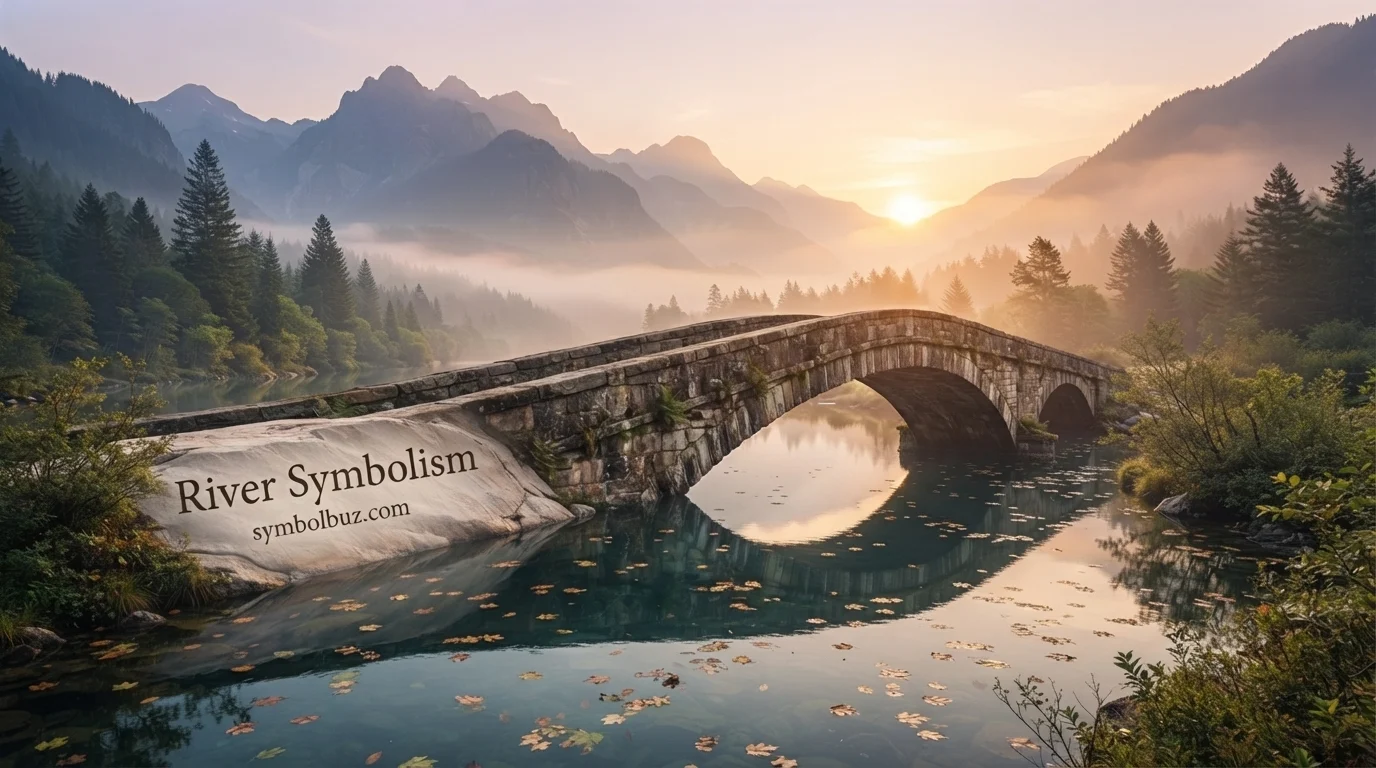
River symbolism is deeply connected with life, change, movement, renewal, and the passage of time. Across cultures and generations, rivers have represented the journey of human life—from its beginning to its destination.
A river can symbolize peaceful growth when its water flows gently, while a wild or flooded river may represent emotional struggles, uncertainty, or major life changes. Its meaning often depends on the water, surroundings, direction, and circumstances in which the river appears.
River Symbolism Meaning (Clear Definition)
River symbolism refers to the symbolic meanings people associate with flowing water and rivers. At its core, a river represents movement, transformation, life, emotional flow, and the journey toward a destination.
Unlike a lake or ocean, a river is always moving. This makes it a powerful symbol of life’s changing nature.
Common meanings of river symbolism include:
| River Symbolism | Symbolic Meaning |
|---|---|
| Flowing river | Life, progress, and natural change |
| Clear river | Peace, clarity, and emotional balance |
| Deep river | Mystery, hidden emotions, and the unknown |
| Fast river | Rapid change, urgency, or strong emotions |
| Calm river | Peace, stability, and acceptance |
| Flooded river | Overwhelming emotions or major challenges |
| Crossing a river | Transition, transformation, or entering a new stage |
| River source | Beginnings, origins, and new possibilities |
| River meeting the ocean | Completion, unity, or reaching a greater purpose |
The deeper message is simple: life, like a river, keeps moving forward.
What Does River Symbolism Represent?
Rivers can represent different ideas depending on their condition and context. Some of the most common river meanings are:
- Life and growth: A flowing river reflects the continuous movement of life.
- Change and transformation: Rivers constantly reshape their surroundings, symbolizing personal transformation.
- Emotional flow: Water is often associated with feelings, intuition, and the subconscious mind.
- Journey and destiny: A river’s path can represent the journey from one stage of life to another.
- Freedom: Flowing water can symbolize releasing control and allowing life to unfold naturally.
- Renewal: Rivers provide water and nourishment, connecting them with restoration and new beginnings.
- Strength and resilience: Even a gentle river can gradually shape rocks, landscapes, and valleys.
River symbolism can therefore have both peaceful and powerful meanings. A quiet stream may suggest acceptance, while a raging river may represent emotional intensity or obstacles.
Spiritual Meaning of River Symbolism
Spiritually, rivers are often viewed as symbols of purification, renewal, transformation, and spiritual movement.
Water has traditionally been associated with cleansing. Because rivers continuously flow, they can represent the process of releasing old experiences and moving toward a renewed state of being.
A river may also symbolize spiritual guidance. Its course does not always follow a straight line, yet it continues toward its destination. This can serve as a reminder that personal growth may involve unexpected turns without meaning that you have lost your way.
River as a Symbol of Spiritual Growth
A river can represent several stages of spiritual development:
- The source — discovering your origins or purpose.
- The journey — learning through experiences and challenges.
- The obstacles — developing patience and resilience.
- The flow — learning to accept change.
- The destination — reaching greater understanding or inner peace.
In this sense, river symbolism encourages people to keep moving while remaining open to life’s natural changes.
Biblical / Religious Meaning of River Symbolism
Rivers have significant symbolic importance in several religious traditions, including Christianity and Judaism.
In the Bible, rivers are associated with life, blessing, abundance, cleansing, boundaries, and God’s provision. The Garden of Eden is described in connection with a river that divided into four branches, making flowing water part of an important creation image.
The Jordan River is especially significant in biblical tradition. It is associated with major events and is strongly connected with baptism, spiritual renewal, and transition.
In Christian symbolism, flowing water can therefore suggest rebirth, purification, grace, and spiritual renewal.
Rivers also appear in other religious traditions. Sacred rivers in Hindu traditions, for example, may be associated with purification, devotion, life, and spiritual liberation.
The exact meaning varies between traditions, but water frequently carries themes of life, cleansing, transformation, and sacred connection.
River Symbolism in History and Culture
Throughout history, rivers have shaped civilizations as much as they have shaped landscapes.
Ancient societies often developed near rivers because flowing water supported agriculture, transportation, trade, and settlement. As a result, rivers became closely connected with prosperity and survival.
The Nile, Tigris, Euphrates, Indus, and Yellow River are examples of waterways that played major roles in the development of ancient civilizations.
Rivers have also served as symbolic boundaries. Crossing a river could mean entering a new territory, leaving an old life behind, or passing from one stage of existence into another.
In many cultures, sacred rivers became places for rituals, prayer, purification, and reflection.
This historical importance explains why rivers continue to carry powerful symbolic meanings today.
River Symbolism in Literature and Art
Writers and artists have long used rivers to express ideas that are difficult to describe directly.
In literature, a river may represent the passage of time, a character’s journey, memory, death, freedom, or transformation. A character standing beside a river may be at an emotional crossroads, while traveling along a river can represent a journey of self-discovery.
Rivers are particularly effective literary symbols because they can be both beautiful and dangerous. Their changing nature mirrors the complexity of human experience.
In visual art, rivers often create a sense of distance and movement. An artist may use a river leading toward the horizon to suggest hope, possibility, or an unknown future.
A dark river can create feelings of mystery or fear, while a bright, clear river can suggest peace and renewal.
Dream Meaning of River Symbolism
Dreams involving rivers can have different interpretations depending on the dreamer’s emotions and the river’s condition.
A calm river may symbolize emotional peace, acceptance, or steady progress. A clear river can suggest clarity and confidence, while a muddy river may reflect confusion or unresolved emotions.
Crossing a river in a dream may symbolize moving through an important transition in life.
A flooded or dangerous river may represent feeling overwhelmed by circumstances or emotions.
Dream symbolism is personal, so the strongest interpretation usually comes from considering how you felt during the dream rather than focusing only on the river itself.
Modern Meaning of River Symbolism
Today, river symbolism remains relevant because modern life is filled with constant change.
People often use rivers as metaphors for personal growth, relationships, careers, creativity, and emotional healing. The idea of “going with the flow” reflects the belief that not every part of life can be controlled.
A river can also represent resilience. It encounters rocks, bends, and barriers, yet it continues moving.
This makes the river a meaningful modern symbol for anyone experiencing change or trying to move forward after a difficult period.
The message is not necessarily to move quickly. Sometimes the lesson is to keep flowing at your own pace.
FAQs:
What is the main meaning of river symbolism?
The main meaning of river symbolism is the journey of life, including movement, change, growth, emotional flow, and transformation.
What does a river symbolize spiritually?
Spiritually, a river can symbolize purification, renewal, spiritual growth, guidance, and the continuous journey toward greater understanding.
What does crossing a river symbolize?
Crossing a river often represents transition. It may symbolize leaving one phase of life behind and entering a new stage.
What does a calm river symbolize?
A calm river commonly represents peace, emotional balance, acceptance, stability, and steady progress.
What does a river symbolize in dreams?
A river in dreams can represent emotions, life’s journey, change, or personal transitions. Its condition and your feelings during the dream can influence its meaning.
Conclusion
River symbolism reminds us that life is a journey rather than a fixed destination. Rivers bend, slow down, become turbulent, and overcome obstacles, yet they continue moving forward.
Whether a river represents life, emotional healing, spiritual renewal, transformation, or resilience, its enduring message is powerful: change is natural, and moving forward can be its own form of strength.

I explore the meanings, history, and cultural significance behind symbols, helping readers understand how symbols connect with ideas, emotions, traditions, and everyday life.