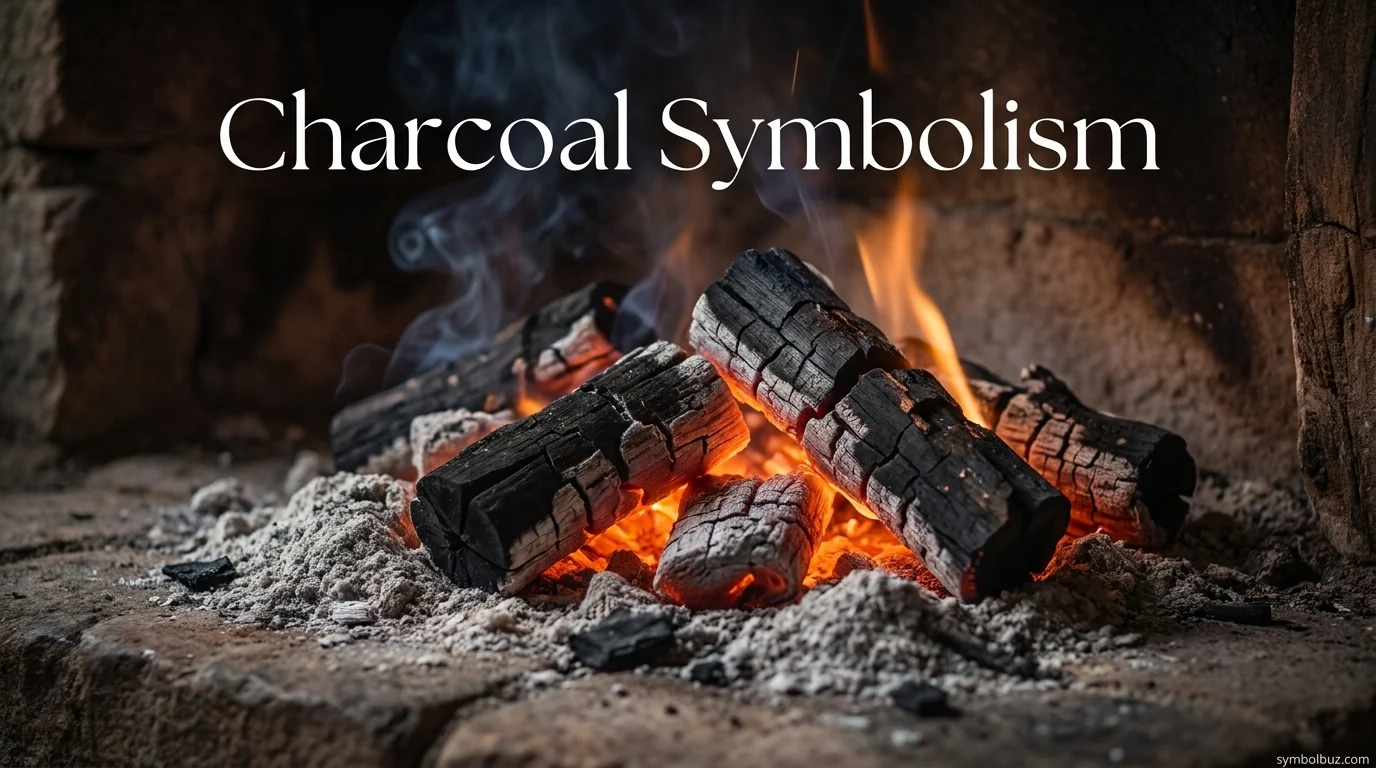
Charcoal symbolism is often connected with transformation, purification, resilience, mystery, and renewal. Created when wood is changed by intense heat, charcoal represents the idea that something can pass through fire and emerge in a new form.
From ancient rituals and artistic traditions to modern design and spiritual reflection, charcoal carries meanings that go beyond its dark appearance. It can symbolize both destruction and creation, reminding us that endings can sometimes become the beginning of something new.
Charcoal Symbolism Meaning (Clear Definition)
The simplest definition of charcoal symbolism is:
Charcoal symbolizes transformation through fire, resilience after hardship, purification, hidden strength, and the potential for renewal.
Charcoal begins as wood but changes dramatically when exposed to high temperatures with limited oxygen. This physical transformation gives it a powerful symbolic connection to personal change.
Its black or deep-gray appearance also contributes to meanings associated with mystery, seriousness, protection, and the unknown.
Depending on the situation, charcoal can represent:
| Symbolic Meaning | What It Represents |
|---|---|
| Transformation | Becoming something new after major change |
| Resilience | Surviving pressure, difficulty, or hardship |
| Purification | Being cleansed or refined through fire |
| Renewal | A new beginning after an ending |
| Mystery | The unknown, hidden truths, or inner depth |
| Strength | Quiet endurance and inner power |
| Creativity | Turning simple materials into meaningful art |
Charcoal therefore has a fascinating dual nature. It can remind us of what has been burned away while also representing what remains and what can still be created.
What Does Charcoal Symbolism Represent?
Charcoal symbolism can represent several important ideas in life and human experience.
1. Transformation
Charcoal is created through an intense process of heat and change. For this reason, it can symbolize a person who has gone through difficult experiences and emerged stronger or wiser.
It suggests that transformation does not always happen comfortably. Sometimes growth requires pressure, patience, and letting go.
2. Resilience
A piece of charcoal is evidence that something survived fire.
Symbolically, this makes charcoal a powerful image of endurance and resilience. It can represent someone who has faced challenges without allowing those experiences to completely destroy their inner strength.
3. Purification
Fire has traditionally been associated with cleansing and purification. Charcoal, as a product of fire, can inherit this symbolic meaning.
It may represent removing old habits, negative influences, or emotional burdens to make space for something healthier.
4. Mystery and the Unknown
Charcoal’s dark color naturally connects it with shadows, hidden things, and mystery.
In symbolic language, it may represent questions that have not yet been answered or parts of ourselves that remain unexplored.
5. Renewal
Charcoal is associated with an ending because something has been burned. Yet it can also become the starting point for another process.
This makes it a symbol of renewal after loss, change after endings, and hope after difficult periods.
6. Quiet Strength
Unlike bright fire, charcoal is dark and understated. It does not demand attention.
Its symbolism can therefore reflect quiet strength—the ability to remain steady without needing recognition.
Spiritual Meaning of Charcoal Symbolism
Spiritually, charcoal symbolism often points toward inner transformation, purification, protection, and spiritual resilience.
Fire has long been used as a metaphor for spiritual testing and personal refinement. Charcoal can represent what remains after those experiences: the lessons, strength, and wisdom gained along the way.
Charcoal as a Symbol of Spiritual Transformation
If charcoal appears as a spiritual symbol, it may encourage you to examine how difficult experiences have changed you.
Rather than viewing hardship only as something negative, charcoal symbolism invites a different perspective: What has the experience taught you, and what stronger version of yourself is emerging?
Charcoal and Protection
Dark materials have sometimes been associated symbolically with protection because they absorb or conceal rather than reflect.
In spiritual interpretation, charcoal may therefore represent creating boundaries, protecting your energy, or stepping away from influences that no longer serve you.
Charcoal and Letting Go
Because charcoal is connected to something that has already passed through fire, it can symbolize leaving the past behind.
Its message may be simple:
Not everything that ends is a failure. Some endings create room for transformation.
Biblical / Religious Meaning of Charcoal Symbolism
Charcoal itself does not have one universal biblical meaning, but burning coals and charcoal appear in biblical passages and religious imagery.
In the Bible, burning coals can appear in contexts involving judgment, purification, divine presence, or powerful encounters. One notable example occurs in Isaiah, where a burning coal from the altar is associated with cleansing and the removal of guilt.
Charcoal also appears in the New Testament narrative surrounding Peter. After Jesus’ arrest, Peter is described as standing near a charcoal fire, and later another charcoal fire appears during the resurrection narrative.
This gives charcoal an interesting symbolic association with testing, memory, restoration, and important spiritual moments.
However, religious symbolism depends heavily on the specific passage, tradition, and interpretation. Charcoal should not be assigned one fixed meaning across every faith or biblical context.
Charcoal Symbolism in History and Culture
Charcoal has been important to human civilization for thousands of years. It has been used for heating, cooking, metalworking, medicine, filtration, and artistic expression.
Its practical importance helped give it symbolic significance.
Ancient Uses
Charcoal was valuable because it could produce intense heat and support metalworking. In cultures where fire and metal were connected with craftsmanship and technological progress, charcoal could indirectly symbolize creation, power, and transformation.
Traditional Healing and Purification
Forms of activated charcoal have been used in various historical medical practices because of their ability to adsorb certain substances.
This practical property contributed to associations between charcoal and cleansing, absorption, and purification, although modern medical use should be based on professional guidance rather than symbolism.
Charcoal in Traditional Practices
In different cultures, charcoal and burned materials have appeared in rituals, household practices, and symbolic acts involving fire.
The exact meaning varies widely. In some settings, burned materials may represent endings or purification, while in others they are simply practical tools.
Charcoal as a Cultural Symbol
Across cultures, the basic transformation from wood to charcoal provides a universal metaphor:
Something ordinary can pass through intense conditions and become something entirely different.
That idea remains meaningful today.
Charcoal Symbolism in Literature and Art
Charcoal has a particularly strong relationship with art because artists have used charcoal as a drawing material for centuries.
Charcoal drawings are often valued for their rich blacks, soft shadows, expressive lines, and ability to create dramatic contrast.
Charcoal as an Artistic Symbol
In visual art, charcoal can represent:
- Impermanence because marks can be erased or altered.
- Raw emotion through expressive, spontaneous strokes.
- Memory through faded or incomplete images.
- Darkness and mystery through deep shadows.
- Simplicity because charcoal is a relatively basic artistic medium.
- Transformation because burned wood becomes a creative instrument.
Charcoal art can therefore mirror the symbolism of charcoal itself: something created through destruction becomes a tool for creation.
Charcoal and Contrast
Artists often use charcoal to explore the relationship between light and darkness.
This can create symbolic themes such as hope and despair, visible and hidden, life and death, or certainty and mystery.
The beauty comes from the contrast.
Dream Meaning of Charcoal Symbolism
Dreams involving charcoal can have different interpretations depending on the dreamer’s emotions and circumstances.
There is no single universal dream meaning, but common symbolic interpretations include transformation, emotional exhaustion, endings, resilience, and hidden feelings.
Dreaming of Burning Charcoal
Burning charcoal may symbolize strong emotions, an ongoing transformation, or a situation that continues to consume your attention.
It can also represent energy that has not yet completely disappeared.
Dreaming of Black Charcoal
Black charcoal may symbolize mystery, uncertainty, hidden emotions, or something from the past that still affects you.
If the dream feels peaceful, it could instead suggest reflection and inner strength.
Dreaming of Charcoal Turning to Ash
Ashes can represent completion, endings, or letting go.
Such a dream may suggest that a chapter of your life is coming to an end and that you are preparing for something different.
Drawing With Charcoal in a Dream
Drawing with charcoal can symbolize self-expression and creativity.
It may indicate a desire to communicate feelings that are difficult to express through ordinary words.
Modern Meaning of Charcoal Symbolism
Today, charcoal symbolism remains relevant because people continue to connect dark colors and fire-related imagery with deeper emotional themes.
In interior design, fashion, branding, photography, and visual culture, charcoal gray is often associated with elegance, maturity, simplicity, strength, and sophistication.
Unlike pure black, charcoal usually feels softer and more understated.
Charcoal Gray Symbolism
Charcoal gray can communicate:
- Sophistication
- Stability
- Professionalism
- Minimalism
- Seriousness
- Balance
- Quiet confidence
This explains why charcoal tones are popular in modern clothing, furniture, architecture, and graphic design.
Charcoal as a Symbol of Personal Growth
On a personal level, charcoal can serve as a reminder that difficult experiences do not have to define the rest of your story.
Fire changes wood into charcoal, but charcoal can still have purpose.
Likewise, a person can experience difficult seasons and still find meaning, creativity, strength, and renewal afterward.
Common Charcoal Symbolism Meanings at a Glance
The symbolism of charcoal can be summarized through these core ideas:
- Transformation — becoming different through powerful experiences.
- Resilience — surviving pressure and hardship.
- Purification — releasing what is no longer needed.
- Renewal — finding a new beginning after an ending.
- Mystery — representing hidden knowledge or unexplored emotions.
- Protection — creating boundaries and shielding oneself.
- Creativity — turning a burned material into a tool for artistic expression.
- Quiet strength — remaining powerful without seeking attention.
FAQs:
What is the main meaning of charcoal symbolism?
The main meaning of charcoal symbolism is transformation through hardship or fire. It can also represent resilience, purification, mystery, and renewal.
What does charcoal symbolize spiritually?
Spiritually, charcoal can symbolize inner transformation, purification, protection, endurance, and letting go of the past. Its meaning often depends on the personal or religious context.
What does charcoal mean in a dream?
Charcoal in a dream may represent transformation, emotional intensity, endings, hidden feelings, or resilience. The meaning can change depending on whether the charcoal is burning, cold, being used, or turning to ash.
What does charcoal gray symbolize?
Charcoal gray commonly represents sophistication, stability, seriousness, quiet confidence, and balance. It offers a softer and more subtle alternative to pure black.
Is charcoal a symbol of rebirth?
Charcoal can symbolize rebirth indirectly because it represents what remains after transformation by fire. Its connection with endings and new possibilities makes it a meaningful symbol of renewal.
Conclusion
Charcoal symbolism carries a powerful message of transformation, resilience, purification, and renewal. Born from fire yet capable of becoming a tool for creation, charcoal reminds us that change can produce unexpected forms of strength and beauty.
If encountered in dreams, spirituality, art, history, or modern design, charcoal invites us to look beyond darkness and recognize the possibility hidden within it.
Sometimes what survives the fire becomes the foundation for something new.

I am Jasmine Marie, an administrator at SymbolBuz. I love exploring symbols and sharing their meanings to help readers understand their deeper stories, messages, and significance.